 USD
USD GBP
GBP  CNY
CNY  EUR
EUR  INR
INR  JPY
JPY  MYR
MYR  ZAR
ZAR  KRW
KRW  THB
THB 


Low-Cost and Commercial Off-the-Shelf Solutions to Drive Transformational Industry Growth
24-Oct-2025
North America
Market Research
PFVL-01-00-00-00
AE_2025_33979
Report Summary: US Military Unmanned Aerial Vehicles Market, 2024–2029
The US military unmanned aerial vehicles market is experiencing robust growth, driven by advances in commercial off-the-shelf solutions, digitization, and national security priorities. In 2024, total contract value reached approximately USD 4.53 billion, with a mature outlook for growth as defense budgets, rapid procurement programs, and new mission profiles expand the unmanned aerial vehicles (UAVs) market. Leading demand segments include MALE UAVs, HALE UAVs, and tactical UAVs, as mission needs focus on intelligence, surveillance, reconnaissance (ISR), force protection, and precision strike roles. Technology boosters—such as AI, swarming, digital engineering, and modular open systems—are transforming platform development, sustainment, and deployment. Strategic imperatives, including rapid RDT&E, resilience in supply chains, and greater public-private-academic collaboration, will continue to shape investment and innovation in the unmanned aerial vehicle (UAV) market.
Key Market Trends & Insights
- Growth fueled by initiatives for low-cost, modular platforms and shift to performance-based logistics.
- AI, autonomous swarming, and digital twin approaches reshape system sustainment and force readiness.
- Budget growth prioritizes MQ-9 Reaper, MQ-25 Stingray, and swarm-enabling mini/small UAVs.
- US-focused supply chain security and investment in additive manufacturing support market resilience.
Market Size & Forecast
- Estimated 2024 total contract value: USD 4,525.1 Million (services and procurement combined).
- FY2026 DoD procurement & RDTE budget: USD 2,187.6 Million, up 26.4% over FY2025.
- MALE UAVs accounted for 45.9% of major contracts in 2024; HALE UAVs 22.8%; tactical UAVs 19.5%.
- Top 5 contractors hold over 86% market share; General Atomics (44.2%), Northrop Grumman (20.0%), and Boeing (15.2%) lead the sector.
Market Overview - US Military Unmanned Aerial Vehicles Market, 2024–2029
The military unmanned aerial vehicles market in the US is evolving rapidly as defense agencies prioritize ISR, force protection, and precision strike with a mix of legacy and next-generation UAVs. MALE, HALE, and tactical UAVs dominate contract activity, with smaller segments for mini/small UAVs, UCAVs, and general procurement, service, and RDT&E efforts. Procurement is balanced by sustainment, logistics, and training services, highlighting a shift to life-cycle and performance-based models.
Current demand is buoyed by the Unleashing US Military Drone Dominance initiative, which accelerates drone programs, procurement authority, and new training ranges, favoring both legacy defense contractors and nimble, small/medium enterprises. Growth is also driven by the integration of AI, edge computing, and autonomous swarm systems—enabling predictive analytics, quicker C2, and multi-vehicle collaboration.
Supply chain resilience, regulatory pressures, and tariffs shape vendor strategies, with increased reliance on US-based component manufacturing and additive manufacturing to mitigate global risks. Digital twin and modular open architectures support rapid prototyping and multi-mission flexibility. Key customer segments span Navy, Air Force, Army, and Special Ops, each with unique requirements: Navy leads funding (46% share), followed by Air Force (30%), with strong spending on HALE (Triton, Global Hawk), MALE (Reaper, Gray Eagle), and tactical systems.
The sector sees high contractor concentration: the top five vendors dominate, with General Atomics' platforms such as MQ-9 Reaper setting procurement benchmarks. The industry is responding to new operational concepts such as swarm tech, autonomous teaming, and networked C5ISR solutions—while also navigating gaps in battery endurance, autonomy, and domestic mass production.
Revenue Forecast - US Military Unmanned Aerial Vehicles Market, 2024–2029
- CY2024 contract value: USD 4,525.1 Million (52.4% services, 43.8% procurement)
- FY2026 DoD budget: USD 2,187.6 Million for UAVs/parts/services — 26.4% rise over FY2025.
- Services (maintenance, support, upgrades) form an increasing share, reflecting the growth of aftermarket and sustainment contracts.
- Future growth is anchored by evolving DoD requirements, rising annual procurement spend, and growing international interoperability and export demand.
Scope of Analysis - US Military Unmanned Aerial Vehicles Market, 2024–2029
This study covers the US military unmanned aerial vehicles market, with a focus on platform procurement, lifecycle sustainment, RDT&E, and related services. Platforms addressed: Mini/Small UAVs, Tactical UAVs, MALE UAVs, HALE UAVs, UCAVs, and General (target/training, MRO, and kit procurement). Major contract recipients and program priorities for Navy, Air Force, Army, and Special Operations are analyzed, alongside DoD multi-year budget trends (CY2024–CY2029). The market excludes classified procurement and focuses on publicly documented acquisition, sustainment, and R&D activities, measuring both procurement and service spending.
Segmentation Analysis - US Military Unmanned Aerial Vehicles Market, 2024–2029
By Platform:
- MALE UAVs: (e.g., MQ-9 Reaper, MQ-1C Gray Eagle) Lead DoD procurement and sustainment, with strong demand for ISR/strike and fleet upgrades.
- HALE UAVs: (e.g., RQ-4 Global Hawk, MQ-4C Triton) Focus on strategic surveillance, maritime domain awareness, and SIGINT missions.
- Tactical UAVs: (e.g., RQ-21 Blackjack, MQ-25 Stingray) Serve brigade-level ISR/targeting and shipborne roles.
- Mini/Small UAVs: (e.g., RQ-11 Raven, BQM-34S) Prioritized for short-range ISR, force protection, and training.
- UCAVs: (e.g., XQ-58 Valkyrie, XQ-67A) Early-stage contracts for R&D, mission systems, and future offensive air combat.
- General: Broader services for MRO, upgrades, mission kits, and swarming/autonomy projects.
By Contract Type:
- Procurement: Purchase of complete platforms and new units, led by MQ-9 Reaper and RQ-21A.
- Service: Upgrades, MRO, logistics, and system integration; fastest-growing share due to PBL models.
- RDT&E: R&D on autonomy, swarming, next-generation propulsion, and advanced mission payloads.
By Department:
- Navy (~46% contract share), Air Force (~30%), Army (~13%), and Special Ops (~11%).
- Navy: Emphasis on tactical and HALE UAVs; Air Force: MALE and HALE; Army/Special Ops: MALE and tactical.
Growth Drivers - US Military Unmanned Aerial Vehicles Market, 2024–2029
- Unleashing US Military Drone Dominance directive streamlines acquisition, training, and operational fielding of new UAVs.
- Defense-wide investments in AI, ML, edge computing, and secure comms enable autonomy, drone swarms, and distributed mission profiles.
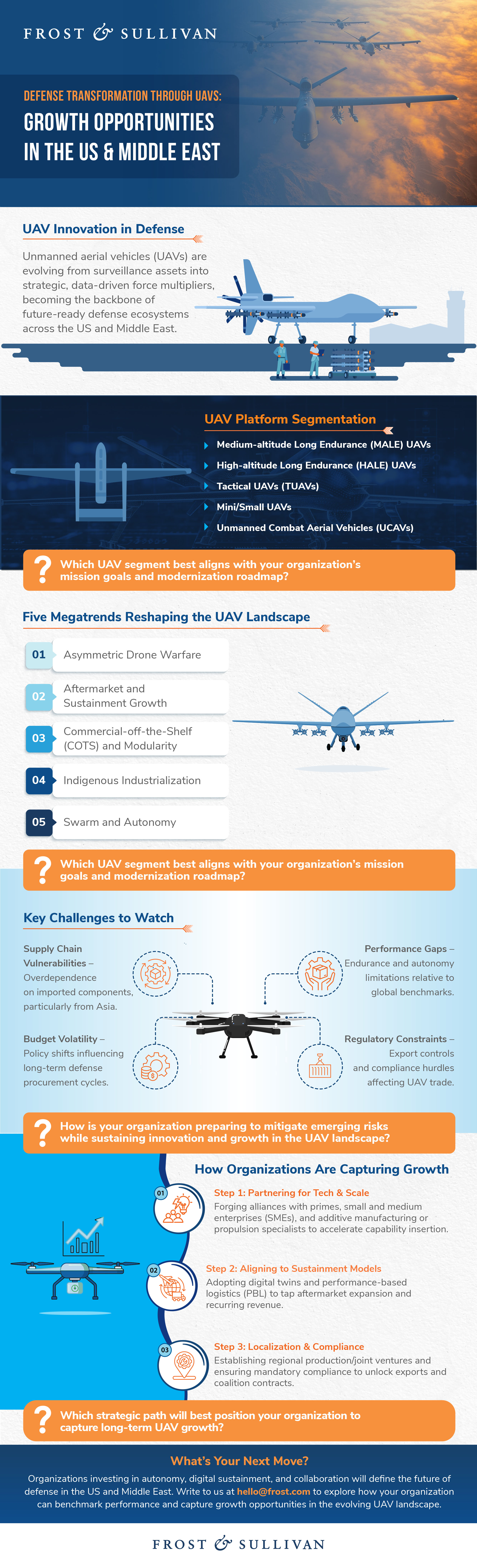
- The push for cost-effective, modular, and commercial off-the-shelf UAVs accelerates platform fielding.
- Growth in the drone aftermarket with rising demand for MRO, components, and performance-based logistics.
- Innovations in digital twin, additive manufacturing, and system interoperability enable rapid tech infusion and streamlined upgrades.
Growth Restraints - US Military Unmanned Aerial Vehicles Market, 2024–2029
- High reliance on Chinese-sourced components is challenged by tariffs, creating cost and vulnerability pressures.
- Technical gaps in endurance, autonomy, and mass production constrain US drone competitiveness versus China, Russia, and Turkey.
- Rising development and production costs threaten DoD export competitiveness and limit international market share.
- Regulatory hurdles, supply chain disruptions, and complex compliance impede rapid deployment of new platforms.
- Budget cyclicality and shifting funding priorities add planning uncertainty for OEMs and suppliers.
Competitive Landscape - US Military Unmanned Aerial Vehicles Market, 2024–2029
- Top Contractors:
- General Atomics Aeronautical: 44.2% CY2024 share, dominant in MALE UAVs with MQ-9 Reaper.
- Northrop Grumman: 20.0%, HALE specialist (MQ-4C Triton, RQ-4 Global Hawk).
- Boeing: 15.2%, tactical (MQ-25 Stingray).
- Insitu and Kratos: Leaders in tactical and UCAV/mini segments.
- Concentration: Top 5 firms hold >86% of US military UAV awards.
- Segment Positioning:
- General Atomics: 97.9% of revenue from MALE UAVs.
- Northrop Grumman: 98.6% from HALE.
- Boeing: Sole focus on tactical UAVs.
- Ecosystem: Extensive partnerships with subsystems providers and academic/research teams.
- Growth Strategies:
- Emphasis on modularity, autonomy, digital twins, additive manufacturing, and rapid prototyping.
- Pursuit of public-private collaborations for RDT&E and rapid technology integration.
Scope of Analysis
UAV Platform Taxonomy
Segmentation
Why is it Increasingly Difficult to Grow?
The Strategic Imperative 8™
The Impact of the Top 3 Strategic Imperatives on the US military UAV Industry
Growth Metrics
Growth Drivers
Growth Restraints
FY2026 Budget Request Overview
FY2026 Budget Request—Funding by Departments
CY2024 Contract Overview
Contracting Department Analysis
UAV Segmentation Analysis
Top Technology/Products by Segment
Competitive Landscape—Contract Share Analysis
Top Companies per Industry Segmentation
Representative Contracts
Growth Opportunity 1: Additive Manufacturing
Growth Opportunity 2: Advanced Propulsion and Energy Systems
Growth Opportunity 3: Swarm Technologies
Benefits and Impacts of Growth Opportunities
Next Steps
List of Exhibits
Legal Disclaimer
Frequently Asked Questions (FAQ) – Military Unmanned Aerial Vehicles Market
1. What is the current size of the US military unmanned aerial vehicles (UAVs) market?
2. Which UAV platform segment receives the most US defense contracts?
3. How is technology influencing the military unmanned aerial vehicles market?
4. Who are the leaders in the US military unmanned aerial vehicles (UAVs) market?
5. What contract types dominate the unmanned aerial vehicle (UAV) market?
6. What are main growth drivers for the military unmanned aerial vehicles market?
7. What restraints challenge unmanned aerial vehicles (UAVs) market growth?
8. Which defense departments lead in UAV procurement and contracts?
9. What technological advancements are shaping future UAV platforms?
10. What is the forecasted outlook for the US military UAV market?
Speak directly with our analytics experts for tailored recommendations.
Recent related Aerospace Systems research
30 Sep 2026 | Global | Market Research
Total Airport Management (TAM) Market, Global, 2025–2034
Total airport management (TAM) represents a high-potential convergence market that integrates enterprise architecture, data management, resource and capacity planning, collaborative decision-making, passenger management, and airport simulation/digital twin into a unified operational framework. TAM r...
28 Sep 2026 | South Asia, Middle East & North Africa | Market Research
Aerospace Engineering Services, India, 2025–2030
India's aerospace engineering services market is evolving from cost-led engineering delivery to higher-value, strategic aerospace engineering participation. The market comprises outsourced engineering services delivered from India by third-party engineering and digital service providers that support...
24 Sep 2026 | North America | Market Research
Military Aviation Maintenance, Repair, and Overhaul Industry, US, 2025–2030
This research service provides a comprehensive overview of the US military aviation maintenance, repair, and overhaul (MRO) industry. The study segments the industry into six platform categories: 1. Fighter, Attack, & Bomber 2. Rotorcraft 3. Transport & Tanker 4. Training & Utility 5. Intelligence, ...
03 Sep 2026 | Global | Technology Research
Photonic and Optical Computing Chips for AI and Data Center Acceleration
The study evaluates photonic and optical computing technologies as critical enablers of next-generation AI infrastructure, addressing growing bandwidth, latency, power consumption, and scalability constraints associated with copper-based interconnects. The analysis covers photonic integrated circuit...
31 Jul 2026 | Global | Market Research
UAV Navigation Systems and Solutions, Global, 2025–2035
This study provides a comprehensive assessment of the global UAV navigation systems and solutions market through a multidimensional framework encompassing geographies, technologies, and applications. The market sizing and competitive assessment use a triangulated methodology that combines demand-sid...
Purchase includes:
- Report download
- Growth Dialog™ with our experts
Growth Dialog™
A tailored session with you where we identify the:- Strategic Imperatives
- Growth Opportunities
- Best Practices
- Companies to Action
Impacting your company's future growth potential.
The study analyzes the Department of Defense's FY2026 annual defense budget to identify funding trends for relevant departments and identify key drivers and restraints projected to impact the industry during the study period. It also assesses relevant contracting activities for calendar year (CY) 2024, including multi-year obligations, to: 1. Explore spending trends across major departments 2. Identify segment-specific leading platform segments and contract trends 3. Examine the contractor landscape and highlight top contractors, their market share, and leading technology/product 4. Highlight the top technology/product and the top 3 contractors for each platform segment
The study also examines policy changes and geopolitical shifts to identify the top 3 growth opportunities projected to sustain industry growth over the study period. It emphasizes the importance of intersectoral collaboration in accelerating the rapid integration of advanced technologies, such as artificial intelligence (AI), autonomous systems, and additive manufacturing (AM), to enhance force posture and operational readiness in contested and rapidly evolving battlefields.
Author: Shreya Khakurel
| Deliverable Type | Market Research |
|---|---|
| Industries | Aerospace, Defence and Security |
| No Index | No |
| Is Prebook | No |
| Keyword 1 | military UAV market |
| Keyword 2 | defense drones forecast |
| Keyword 3 | US unmanned systems |
| Podcast | No |
| Predecessor | None |
| WIP Number | PFVL-01-00-00-00 |