 USD
USD GBP
GBP  CNY
CNY  EUR
EUR  INR
INR  JPY
JPY  MYR
MYR  ZAR
ZAR  KRW
KRW  THB
THB 


Audio Conferencing Devices Market, Global, 2024–2031 Updated Research Available
Audio Conferencing is Experiencing Transformational Growth Due to Demand for Intelligent Audio
29-Oct-2025
Global
Market Research
MHCB-01-00-00-00
TE_2025_33997
Report Summary: Audio Conferencing Devices Market
The Audio-Conferencing Devices Market was valued at USD 1.08 billion in 2024 and is projected to reach USD 2.19 billion by 2031, expanding at a CAGR of 10.7%. Market momentum is driven by the growing need for AI-enhanced collaboration tools, hybrid work enablement, and the integration of intelligent audio endpoints into unified communication ecosystems.
North America and Europe remain key revenue centers due to strong enterprise adoption of UCaaS platforms such as Microsoft Teams, Zoom, and Cisco Webex, while Asia-Pacific is emerging as the fastest-growing region, supported by the rise of hybrid workplaces and government digitization programs.
Key Market Insights:
- Installed audio endpoints (DSPs and microphones) are driving new deployments in mid-to-large meeting rooms.
- Tabletop endpoints (USB and TDM/IP phones) continue to decline as all-in-one UC systems expand.
- AI-driven noise suppression, auto-calibration, and voice recognition features are becoming standard.
- Education, healthcare, and government are emerging high-growth verticals for hybrid collaboration.
The market is rapidly evolving toward intelligent, software-defined audio ecosystems, with vendors competing on integration flexibility, AI capabilities, and cross-platform interoperability.
Market Overview: Audio Conferencing Devices Market
The global audio conferencing devices market is transitioning from a hardware-centric business to a software-integrated communication ecosystem. Demand for intelligent conferencing solutions has surged as organizations embrace hybrid work, remote collaboration, and virtual meeting infrastructure.
Frost & Sullivan’s ICT research indicates that enterprises are increasingly investing in AI-powered digital signal processors (DSPs), beamforming microphones, and network-based control systems that deliver immersive, consistent, and equitable meeting experiences. The integration of AI and cloud-based management tools has transformed audio devices into adaptive, learning-enabled systems capable of optimizing sound performance in real time.
Key Market Trends:
- AI and Machine Learning Integration: Automated noise reduction, real-time transcription, and intelligent voice isolation are now standard features.
- Shift to Installed Audio Systems: Organizations are replacing legacy tabletop units with scalable DSP-based room solutions for larger collaboration spaces.
- UCaaS Integration: Seamless compatibility with platforms such as Zoom, Teams, and Webex is now a top purchase criterion.
- Sustainability and Lifecycle Management: Manufacturers are emphasizing eco-friendly materials, remote firmware updates, and modular hardware design.
- Pricing Consolidation and Channel Expansion: Vendors are leveraging cloud marketplaces and managed service models to enhance recurring revenue streams.
Regional Overview:
- North America: Accounts for 41% of revenue; early adoption of UCaaS and AI-driven collaboration tools.
- Europe: Focused on hybrid meeting equity and energy-efficient office technologies.
- Asia-Pacific: Fastest growth rate (CAGR 11.5%) fueled by post-pandemic digitization in enterprise and education sectors.
- Latin America and MEA: Early adoption phase, led by government modernization projects.
The audio conferencing ecosystem is increasingly merging with video collaboration, room automation, and IoT-based analytics. As enterprises redefine workspace design, the demand for integrated, intelligent, and easily deployable audio solutions will continue to accelerate across industries and regions.
Scope of Analysis: Audio-Conferencing Devices Market
This study evaluates the Audio Conferencing Devices Market, Global, 2024–2031, assessing growth potential, technology trends, and competitive strategies.
Geographic Coverage:
- Regions: North America, Europe, Asia-Pacific, Latin America, Middle East & Africa
- Base Year: 2024 | Forecast Period: 2025–2031
Market Segmentation:
- By Product Type: Tabletop Endpoints (USB, TDM/IP Phones), Installed Endpoints (DSPs, Microphones, Mixers)
- By Application: Corporate, Education, Healthcare, Government, SMB
- By Connectivity: Wired, Wireless, IP-based
- By Deployment: On-premises and Cloud-integrated
The analysis integrates primary interviews with OEMs, channel partners, and enterprise IT leaders, supported by Frost & Sullivan’s proprietary database and secondary data sources. The study identifies key investment trends, product innovations, and strategic shifts shaping the evolution of audio conferencing devices from standalone hardware to intelligent collaboration systems.
Revenue Forecast: Audio Conferencing Devices Market
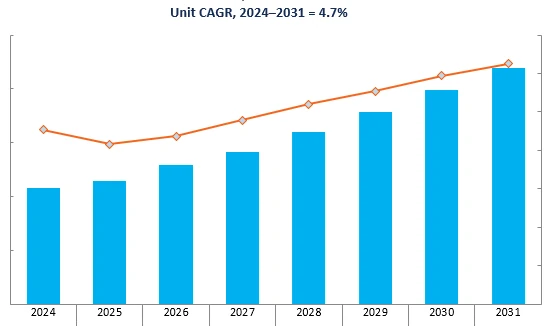
The global audio conferencing devices market is expected to grow from USD 1.08 billion in 2024 to USD 2.19 billion by 2031, representing a CAGR of 10.7%.
By Region:
- North America: 41.8% market share in 2024; steady expansion with hybrid workspace optimization.
- Europe: 33.6% share; growth supported by ESG-linked modernization of corporate AV systems.
- Asia-Pacific: 21% share; fastest-growing region with increased adoption in education and government sectors.
By End-User Vertical:
- Enterprise and Corporate: Largest revenue contributor (>60%).
- Education and Government: Strong growth driven by hybrid learning and e-governance infrastructure.
- Healthcare: Emerging opportunity for telemedicine and digital consultations.
Revenue acceleration is expected to continue as AI-based voice control, noise suppression, and room-aware sound calibration redefine user experience across conferencing endpoints and integrated collaboration environments.
Segmentation Analysis: Audio Conferencing Devices Market
By Product Type:
- Installed Audio Endpoints (DSPs, Microphones, Mixers): Account for over 60% of market revenue; growth fueled by hybrid meeting rooms requiring scalable and networked solutions.
- Tabletop Audio Endpoints (USB/TDM phones): Declining share due to commoditization and substitution by integrated AV systems.
By Application:
- Corporate: Dominant segment; large-scale UCaaS integration and smart office deployment.
- Education: Increasing investment in hybrid classroom systems with DSP-enabled audio distribution.
- Healthcare: Adoption for teleconsultation and training rooms.
- Government: Rising demand for secure, policy-compliant conferencing infrastructure.
By Connectivity:
- IP and Wireless Systems: Increasing penetration as enterprises upgrade legacy wired systems to reduce installation complexity.
By Region:
- North America and EMEA: Mature markets emphasizing security and certification.
- Asia-Pacific: Significant volume growth due to digital transformation investments.
Segmentation trends confirm a strong transition from standalone tabletop devices to AI-driven installed systems capable of unified management, analytics, and seamless multi-platform integration.
Growth Drivers: Audio Conferencing Devices Market
- Hybrid Work Transformation: Persistent demand for equitable and flexible collaboration experiences.
- AI and Automation: Real-time noise suppression, voice tracking, and meeting transcription enhance engagement.
- Cloud-Integrated UC Platforms: Interoperability with Teams, Zoom, and Webex boosts enterprise adoption.
- Digital Transformation in Education and Healthcare: Audio infrastructure supporting virtual classrooms and telemedicine.
- Sustainability and ESG Initiatives: Preference for energy-efficient, upgradable devices with lower carbon footprints.
These drivers collectively position the audio conferencing devices market for sustained growth as enterprises continue to converge audio, video, and control systems into cohesive collaboration frameworks.
Growth Restraints: Audio Conferencing Devices Market
- Market Commoditization: Price competition limits profitability, especially in the tabletop segment.
- Integration Complexity: Legacy system interoperability challenges across AV ecosystems.
- All-in-One Video Bars: Cannibalization of standalone audio devices as hybrid solutions gain popularity.
- Economic Slowdown: Deferred technology upgrades among SMEs and public institutions.
- Cybersecurity Risks: Growing vulnerabilities in IP-enabled audio conferencing networks.
While cost pressures persist, vendors focusing on AI differentiation, device security, and multi-platform optimization are expected to overcome commoditization challenges and capture higher-value opportunities.
Competitive Landscape: Audio Conferencing Devices Market
The audio conferencing devices market is moderately consolidated, with leading vendors prioritizing AI innovation, platform interoperability, and ecosystem expansion.
Key Companies:
- Biamp Systems: Dominates installed audio solutions with integrated DSPs and network-based control systems.
- Shure Inc.: Leader in enterprise microphones with IntelliMix DSP and Teams-certified devices.
- Jabra (GN Audio): Strong in hybrid work solutions and smart speakerphones.
- Poly (HP): Focuses on intelligent audio endpoints integrated into HP’s hybrid work portfolio.
- Yamaha Unified Communications: Recognized for acoustic optimization and ADECIA systems.
- Q-SYS (QSC): Expanding presence in software-based, scalable audio processing.
- Sennheiser and ClearOne: Competing in premium conferencing and installed room audio solutions.
Strategic Trends:
- AI-Driven Audio Enhancement: Advanced algorithms for adaptive echo cancellation and ambient learning.
- Hardware-Software Convergence: Unified control platforms for cross-device interoperability.
- Vertical Integration: Partnerships with UCaaS providers and AV integrators.
- Sustainability Focus: Modular upgrades and remote device lifecycle management.
The competitive landscape is evolving toward ecosystem-driven differentiation, where vendors offering end-to-end intelligent collaboration experiences—spanning audio, video, and control—will lead the next phase of market consolidation.
Scope of Analysis
Segmentation
Market Segmentation and Definitions: Tabletop Endpoints
Market Segmentation and Definitions: Installed Audio Conferencing Devices
Market Overview
Why is it Increasingly Difficult to Grow?
The Strategic Imperative 8™
The Impact of the Top 3 Strategic Imperatives on the Audio Conferencing Devices Industry
Value Chain
Competitive Environment
Key Competitors
Evolution of Audio Conferencing
Target Markets
Importance of Capabilities for Room-Based Video Conferencing
Proliferation of Audio Devices
Medium-Sized Meeting Rooms: Key to Success
Market Trend Matrix by Room Size
Integration of DSP Into Audio Devices
DSP Software vs Hardware
The Evolving Role of Networked Audio in DSP Systems
Audio over IP AoIP Standards
Enhanced Connectivity and Integration of Ecosystems
Bundling Power and Ecosystem Integration in the Evolving Audio Conferencing Market
Integrating Audio and Video Control
Voice, Beamforming, and Conferencing Product Differentiation
Combining AI and Audio
Growth Metrics
Growth Drivers
Growth Driver Analysis
Growth Restraints
Growth Restraint Analysis
Forecast Considerations
Revenue and Unit Shipment Forecast
Revenue Forecast by Product
Revenue Forecast by Region
Revenue Forecast Analysis
Unit Shipment Forecast by Product
Unit Shipment Forecast by Region
Pricing Trends and Forecast Analysis
Revenue Share: TDM/IP Conference Phone and USB Speakerphone
Revenue Share: Audio Conferencing Microphones and DSPs
Growth Metrics
Revenue and Unit Shipment Forecast
Revenue Forecast by Region
Unit Shipment Forecast by Region
Forecast Analysis
Growth Metrics
Revenue and Unit Shipment Forecast
Revenue Forecast by Product
Revenue Forecast by Region
Unit Shipment Forecast by Product
Unit Shipment Forecast by Region
Forecast Analysis
Growth Metrics
Revenue and Unit Shipment Forecast
Revenue Forecast by Region
Unit Shipment Forecast by Region
Forecast Analysis
Growth Metrics
Revenue and Unit Shipment Forecast
Revenue Forecast by Region
Unit Shipment Forecast by Region
Forecast Analysis
Growth Opportunity 1: Deepen AI Integration for Enhanced User Experience and Productivity
Growth Opportunity 2: Develop Comprehensive Integrations with UC Platforms
Growth Opportunity 3: Focus on Premium Meeting Room Solutions and Specialized Form Factors
Growth Opportunity 4: Address the ROI of Audio
Growth Opportunity 5: Prioritize Global Scalability, Security, and Compliance
Benefits and Impacts of Growth Opportunities
Next Steps
List of Exhibits
Legal Disclaimer
Frequently Asked Questions (FAQ) – Audio Conferencing Devices Market, Global, 2024–2031
1. What is the current size and forecast for the Audio Conferencing Devices Market?
2. What are the main product segments in this market?
3. Which regions lead adoption of audio conferencing devices?
4. How is AI changing audio conferencing devices?
5. Which end-user verticals offer the largest opportunities?
6. What are the primary restraints on market growth?
7. Which companies lead the Audio Conferencing Devices Market?
8. How important is UCaaS compatibility for audio devices?
9. What is the expected product mix change through 2031?
10. What is the long-term outlook for the market?
Speak directly with our analytics experts for tailored recommendations.
Recent related Unified Communications and Collaboration (UCC) research
08 Oct 2026 | Global | Customer Research
Growth Opportunities for Communications and Collaboration in the Government Sector
Data from Frost & Sullivan's IT Decision Maker survey shows that government communications are entering a decisive new phase. The research finds that modernization is moving beyond routine technology replacement. Agencies now want communications platforms that improve public services, support employ...
07 Oct 2026 | Global | Market Research
Global Audio-Conferencing Devices Market Forecast to 2032
For years, while cameras drew the attention and budget in meeting rooms, audio was often a second thought. That assumption has expired. Audio now sits at the center of meeting equity and collaboration effectiveness, because even the sharpest image is useless if people cannot be heard and understood ...
28 Sep 2026 | Global | Frost Radar
Frost Radar™: Communications Platform as a Service, 2026
Communications platform as a service (CPaaS) has become foundational infrastructure for digital business, embedding programmable voice, messaging, and video into the applications where customers and employees engage. Enterprises are rearchitecting their communication workflows around programmable in...
24 Sep 2026 | Global | Customer Research
UCC Buyers’ Perspective: Investment Priorities in 2026 and Beyond
This research examines enterprise buyer priorities, investment plans, and purchasing behaviors related to Unified Communications and Collaboration (UCC) technologies through 2029, based on Frost & Sullivan’s 2026 global Information Technology Decision-Maker (ITDM) survey. The study explores how orga...
09 Sep 2026 | Global | Technology Research
Unified Cloud Control: The Emergence of Intelligent Multi-Cloud Management Platforms, 2026-2030
This report emerges as the evolution of an integrated cloud manipulation management system as complementary technology for employer cloud manipulation management systems to enable businesses to manage increasingly distributed workloads in public, private, hybrid, edge, and sovereign clouds in one ma...
Purchase includes:
- Report download
- Growth Dialog™ with our experts
Growth Dialog™
A tailored session with you where we identify the:- Strategic Imperatives
- Growth Opportunities
- Best Practices
- Companies to Action
Impacting your company's future growth potential.
Author: Chris Pennell
| Deliverable Type | Market Research |
|---|---|
| Industries | Telecom |
| No Index | No |
| Is Prebook | No |
| Keyword 1 | audio conferencing market |
| Keyword 2 | UC hardware 2031 |
| Keyword 3 | collaboration devices |
| Podcast | No |
| Predecessor | MH34-01-00-00-00 |
| WIP Number | MHCB-01-00-00-00 |