 USD
USD GBP
GBP  CNY
CNY  EUR
EUR  INR
INR  JPY
JPY  MYR
MYR  ZAR
ZAR  KRW
KRW  THB
THB 


Human-Machine Integration/Manned-Unmanned Teaming, Global, 2025–2027
Strategic Convergence MUM-T Reshapes Force Multiplication and Operational Dominance
26-Dec-2025
Global
Market Research
PG6E-01-00-00-00
AE_2025_34233
Report Summary: Military Manned–Unmanned Teaming (MUM-T) Market
The global military manned-unmanned teaming (MUM-T) market was valued at USD 5.0 billion in 2024 and is projected to reach USD 7.64 billion by 2027, growing at a CAGR of 15.2% from 2024 to 2027. Market growth is driven by the rapid transition of MUM-T from experimental concepts to deployable capabilities across air, land, and naval domains, as armed forces prioritize multi-domain operations, force survivability, and operational flexibility. The expanding role of autonomy, AI-enabled decision support, and secure communications is reinforcing MUM-T as a core component of the broader Human–Machine Integration market.
Key Market Trends & Insights
- North America accounted for the largest share of the MUM-T market in 2024, supported by sustained U.S. Department of Defense investments in manned–unmanned integration programs.
- In the U.S., growing emphasis on interoperability, swarming, and open systems architecture is accelerating deployment of MUM-T–enabled platforms across services.
- Europe is witnessing rising adoption, driven by NATO modernization initiatives and multinational collaboration programs focused on standardization and joint operations.
- Increasing integration of AI, machine learning, and autonomous control systems is reducing operator workload and enhancing mission effectiveness across the military manned-unmanned teaming (MUM-T) market.
- Asia-Pacific and the Middle East are emerging growth regions, supported by regional security priorities and selective increases in defense spending.
Market Size & Forecast
- 2024 Market Size: USD 5.0 Billion
- 2027 Projected Market Size: USD 7.64 Billion
- CAGR (2024–2027): 15.2%
- North America: Largest Market in 2024
- Europe & Asia-Pacific: Fastest-growing regions during the forecast period
The increasing reliance on coordinated human–machine operations and scalable autonomous teaming solutions is expected to sustain strong growth in the MUM-T market over the forecast period.
Market Overview & Trends: Military Manned–Unmanned Teaming (MUM-T) Market
The military manned-unmanned teaming (MUM-T) market is evolving in response to shifting battlefield requirements that emphasize speed, adaptability, and resilience across contested environments. Defense forces are increasingly adopting MUM-T concepts to integrate manned aircraft, armored vehicles, and naval platforms with unmanned aerial, ground, and maritime systems. This integration enables extended stand-off operations, improved situational awareness, and reduced risk to personnel—key objectives within the broader Human–Machine Integration market.
A defining trend shaping the MUM-T market is the advancement of artificial intelligence and machine learning, which supports higher levels of autonomy and real-time decision-making. These technologies enable unmanned systems to act as sensors, decoys, or effectors while remaining under meaningful human control. Parallel to this, Modular Open Systems Architectures (MOSA) are gaining traction, allowing defense organizations to upgrade legacy platforms with MUM-T capabilities without full system replacement.
Another major trend is the growing emphasis on interoperability. NATO and allied forces are aligning MUM-T development with standardized Levels of Interoperability (LOI), enabling seamless coordination across multinational operations. As competitive intensity increases, the military manned-unmanned teaming (MUM-T) market is also attracting non-traditional defense-tech firms, accelerating innovation cycles and reshaping procurement strategies.
Scope of Analysis: Military Manned–Unmanned Teaming (MUM-T) Market
This study examines the global military manned-unmanned teaming (MUM-T) market within the context of the evolving Human–Machine Integration market. The analysis covers global defense spending, technology adoption trends, growth drivers, restraints, and strategic imperatives influencing MUM-T development and deployment. The study period spans 2024–2027, with 2024 as the base year and 2025–2027 as the forecast period.
The scope includes MUM-T applications across air, land, and naval domains, encompassing operational use cases such as intelligence, surveillance, reconnaissance (ISR), electronic warfare, strike missions, and logistics support. Market insights are supported by a combination of primary research (approximately 20%) and secondary research, including Frost & Sullivan’s proprietary databases and expert interviews with defense industry stakeholders.
Geographically, the analysis covers North America, Europe, Asia-Pacific, the Middle East, Latin America, and Africa, highlighting regional adoption patterns and defense modernization priorities. All financial values are presented in U.S. dollars, and findings reflect verified contract data and government defense programs
Revenue & Spending Forecast: Military Manned–Unmanned Teaming (MUM-T) Market
The military manned-unmanned teaming (MUM-T) market is transitioning from early-stage development toward scalable and operational deployment, reflecting its growing strategic importance in next-generation defense modernization. Increasing emphasis on multi-domain operations across air, land, and naval forces is positioning MUM-T as a core capability within future force structures. This shift underscores strong defense sentiment toward enhanced situational awareness, survivability, and force multiplication enabled through human–machine collaboration.
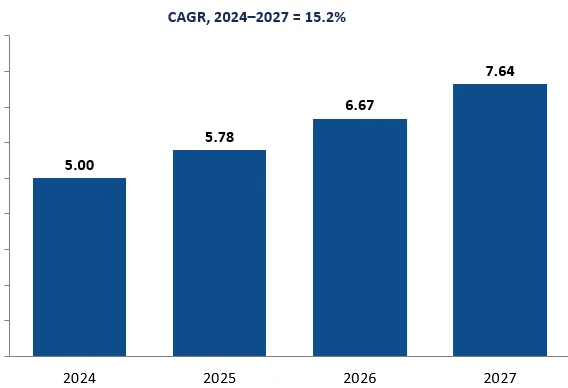
Globally, the MUM-T market is projected to expand from USD 5.0 billion in 2024 to USD 7.64 billion by 2027, registering a compound annual growth rate (CAGR) of 15.2% over the forecast period. This robust growth trajectory reflects rising adoption and scalable procurement opportunities, supported by sustained investments in artificial intelligence, autonomous swarming, secure communications, and open systems architectures. The forecast indicates consistent year-over-year expansion as MUM-T moves from pilot programs to broader force integration.
From a regional perspective, North America represents the largest and most technologically advanced market, supported by continued U.S. Department of Defense investments in MUM-T–enabled platforms and advanced interoperability frameworks. Europe is also demonstrating strong momentum, driven by NATO modernization initiatives, multinational collaboration programs, and an increased focus on standardization amid heightened geopolitical pressures. Meanwhile, Asia-Pacific and the Middle East are expected to experience steady growth as regional security priorities drive selective investment in autonomous teaming and unmanned system integration.
Overall, the forecast highlights sustained global procurement momentum, with leading regions setting the pace for technological advancement while emerging regions progressively expand adoption aligned with evolving defense requirements.
Market Segmentation Analysis: Military Manned–Unmanned Teaming (MUM-T) Market
The military manned-unmanned teaming (MUM-T) market is segmented by operational domain, reflecting how human-machine collaboration is deployed across defense environments. In the land domain, MUM-T enables coordinated operations between crewed armored vehicles and unmanned ground systems, enhancing reconnaissance, force protection, and firepower while reducing exposure to high-risk threats.
Within the naval domain, MUM-T integrates crewed vessels with unmanned surface and underwater vehicles to support ISR, mine countermeasures, electronic warfare, and anti-submarine missions. These capabilities are increasingly critical as maritime security challenges intensify in contested waters.
The air domain represents a rapidly advancing segment of the MUM-T market, where crewed aircraft collaborate with unmanned aerial systems to extend strike range, enable swarm tactics, and support next-generation air combat concepts. Across all domains, the Human–Machine Integration market underpins these segments through AI-driven autonomy, secure communications, and interoperable command frameworks.
Growth Drivers: Military Manned–Unmanned Teaming (MUM-T) Market
The military manned-unmanned teaming (MUM-T) market is being propelled by its growing role as a foundational element of modern military concepts of operations (ConOps). Armed forces worldwide are increasingly integrating manned and unmanned platforms across aerial, naval, and ground domains to enhance situational awareness, expand operational reach, and improve force survivability. By coordinating assets across multiple domains, MUM-T enables more flexible and effective responses in complex, multi-threat operational environments, positioning it as a core capability within the broader Human–Machine Integration market.
Technological advancements represent another critical growth driver. The operational value of MUM-T is closely tied to evolving systems architectures and advanced communication frameworks that support varying Levels of Interoperability (LOI). Progress in artificial intelligence and machine learning is enabling higher degrees of autonomy, faster decision-making, and more efficient data prioritization. AI-driven analytics are reducing cognitive burden on human operators by filtering large volumes of sensor data and delivering actionable intelligence to mission controllers in near real time. These improvements are expected to have a stronger impact over the medium term as systems mature and deployment scales increase.
Sustained and targeted defense budget allocations further reinforce growth momentum in the MUM-T market. Governments are increasingly validating MUM-T as a strategic priority through funding for acquisition, prototyping, and operational deployment. Although MUM-T currently represents a modest share of total defense spending, its projected growth rate outpaces that of traditional defense platforms. This budgetary prioritization is expected to accelerate adoption and reinforce the long-term expansion of the military manned-unmanned teaming (MUM-T) market through 2027.
Growth Restraints: Military Manned–Unmanned Teaming (MUM-T) Market
The military manned-unmanned teaming (MUM-T) market faces several operational and technical restraints that may moderate adoption during the forecast period. One of the primary challenges is operational risk, as effective MUM-T deployment requires precise coordination between manned and unmanned platforms. As autonomy levels increase—particularly in target detection and engagement—the risk of timing errors, spatial misalignment, fratricide, or unintended escalation rises, especially in dynamic and contested combat environments.
Cybersecurity vulnerabilities represent another critical restraint. MUM-T systems rely heavily on wireless communications, making them susceptible to cyber intrusions, espionage, data breaches, and electronic warfare. While efforts to leverage 5G-enabled tactical networks aim to support low-latency, high-bandwidth operations, such technologies remain experimental in most defense settings and are particularly vulnerable in contested operational theaters.
The growing cognitive burden on military operators also poses a significant limitation. As MUM-T operations increase in complexity, operators must manage multiple data streams and real-time decision points simultaneously. This places pressure on training requirements, interface design, and human-machine coordination. Addressing these challenges is essential to maintaining mission effectiveness while navigating emerging ethical and legal considerations surrounding human oversight.
Finally, integration challenges continue to restrict scalability. Diverse manned and unmanned platforms often operate under inconsistent standards, creating interoperability gaps. Ensuring reliable communication, robust data exchange, sufficient bandwidth, and secure signal quality remains technically complex. Although demand for open and agile IT architectures is rising, tailoring MUM-T concepts of operations to meet diverse end-user requirements continues to slow widespread deployment across defense forces.
Scope of Analysis
Research Methodology
Market Segmentation
Why Is It Increasingly Difficult to Grow?
The Strategic Imperative 8™
The Impact of the Top 3 Strategic Imperatives on the MUM-T Industry
Growth Drivers
Growth Restraints
MUM-T NATO Protocol for Military Levels of Interoperability (LOI)
Market Trends Analysis
Key Vendors by Segment
Regional Analysis
Spending Forecast
Spending Forecast by Region
Market Forecast Analysis
MUM-T Main Build-up Programs: United States
Representative MUM-T Contracts: United States
Representative MUM-T Programs: Europe
Representative MUM-T Contracts: Europe
Representative MUM-T Programs: Other Regions
Representative MUM-T Contracts: Other Regions
Growth Opportunity 1: Procurement
Growth Opportunity 2: Research & Development
Growth Opportunity 3: Defense-Tech's Impact on the MUM-T Industry
Abbreviations and Acronyms
Benefits and Impacts of Growth Opportunities
Next Steps
List of Exhibits
Legal Disclaimer
Frequently Asked Questions (FAQ) – Military Manned–Unmanned Teaming (MUM-T) Market
1. What is the military manned–unmanned teaming (MUM-T) market?
2. What was the global MUM-T market size in 2024?
3. What is the projected market size by 2027?
4. What is the expected growth rate of the MUM-T market?
5. Which military domains use MUM-T systems?
6. What are the key drivers of growth in the MUM-T market?
7. What challenges restrain the adoption of MUM-T systems?
8. Which region leads the MUM-T market?
9. How does the MUM-T market relate to the Human–Machine Integration market?
10. What is the future outlook for the military MUM-T market?
Speak directly with our analytics experts for tailored recommendations.
Recent related Defense research
07 Oct 2026 | North America | Frost Radar
Frost Radar™: US Military Intelligence Analytics, 2026
The US military intelligence (MILINT) analytics industry is undergoing a structural transformation as defense and intelligence agencies transition from platform-centric architectures to AI-native, data-centric, and decision-driven operational models. Intelligence systems are no longer confined to po...
30 Sep 2026 | Global | Market Research
Total Airport Management (TAM) Market, Global, 2025–2034
Total airport management (TAM) represents a high-potential convergence market that integrates enterprise architecture, data management, resource and capacity planning, collaborative decision-making, passenger management, and airport simulation/digital twin into a unified operational framework. TAM r...
24 Sep 2026 | North America | Market Research
Military Aviation Maintenance, Repair, and Overhaul Industry, US, 2025–2030
This research service provides a comprehensive overview of the US military aviation maintenance, repair, and overhaul (MRO) industry. The study segments the industry into six platform categories: 1. Fighter, Attack, & Bomber 2. Rotorcraft 3. Transport & Tanker 4. Training & Utility 5. Intelligence, ...
03 Sep 2026 | Global | Technology Research
Photonic and Optical Computing Chips for AI and Data Center Acceleration
The study evaluates photonic and optical computing technologies as critical enablers of next-generation AI infrastructure, addressing growing bandwidth, latency, power consumption, and scalability constraints associated with copper-based interconnects. The analysis covers photonic integrated circuit...
25 Aug 2026 | North America | Market Research
US Military Intelligence Analytics Industry Growth Opportunities, 2025–2028
The US military intelligence (MILINT) analytics market is undergoing rapid transformation driven by the convergence of AI, big data analytics, and next-generation sensing. As the DoW and the wider intelligence community (IC) face increasingly complex multi-domain threats, the demand for scalable, re...
Purchase includes:
- Report download
- Growth Dialog™ with our experts
Growth Dialog™
A tailored session with you where we identify the:- Strategic Imperatives
- Growth Opportunities
- Best Practices
- Companies to Action
Impacting your company's future growth potential.