 USD
USD GBP
GBP  CNY
CNY  EUR
EUR  INR
INR  JPY
JPY  MYR
MYR  ZAR
ZAR  KRW
KRW  THB
THB 


Offensive Laser and Microwave Systems Form the Next Defense Market Ready to Boom
A new era of advanced weaponry is evolving and has prompted the US Department of Defense (DoD), along with several national laboratories and defense agencies to accelerate the development of directed energy (DE) for use as weapons. Hypersonic and ballistic missiles, unmanned aerial vehicle swarms, and improvised terror attacks are some of the most significant threats to US air, ground, naval, and space assets. The development of high energy lasers (HELs) and electromagnetics (EMs) will arm the US arsenal with a low-cost solution. In addition, DE weapons will be capable of multiple shots at multiple targets whose only limitation will be power. US defense spending on this emerging market is ready to flourish. US adversaries such as China and Russia are also working toward their own DE developments.
The US DoD defines DE as an umbrella term covering technologies that produce concentrated electromagnetic energy and atomic or subatomic particles. A DE weapon is a system using DE primarily as a means to incapacitate, damage, disable, or destroy enemy equipment, facilities, and/or personnel. It also includes actions taken to protect friendly equipment, facilities, and personnel and retain friendly use of the EM spectrum. With the maturation of DE technology, weaponized DE systems are becoming more prolific, powerful, and a significant subset of the electronic warfare (EW) mission area. DE examples include active denial technology, lasers, radio frequency (RF) weapons, and DE anti-satellite and high-powered microwave (HPM) weapon systems.
This research reviews the developing DE weapons market within the US Defense industry. Although laser technology has been in existence since the early 1960s, and microwave even earlier than that, present trends within the DoD are focused on the further development of these capabilities into operational weapons.
Spending forecasts are based on the fiscal year (FY) 2019 budget requests, which in this case are isolated to RDTE funding. Readers should bear this in mind as this type of spending is based on progress of some programs, termination of projects that prove a hypothesis, and the initiation of new advanced programs effected by results of finished initiatives. Market share for this effort is established by use of government contracts awarded within FY 2017, which is the established base year for this effort. However, because this research took place near the end of FY 2018, additional contracts awarded during FY 2018 and competitor activity are included to furnish readers a better insight into the make-up of this developing market. Note: The cutoff date of research data for this effort is 31 Aug 2018.
The research is segmented by the defense service agencies involved in the development of DE weapons under four distinct venues: air, land, sea, and space. As such, this effort will analyze how the US Air Force, Army, Navy, and Joint organizations are investing funds in the development of this fast emerging market.
Key Issues Addressed
- How much funding is the DoD investing in the development of DE weapons and what agencies are involved?
- Which companies are directly participating with the DoD in the development of DE weapons systems and what key roles are they playing?
- What factors are driving or restraining the development of DE weapons systems?
- What specific opportunities exist while DE weapons are being developed?
- As more prototypes become available for testing where will opportunities evolve in manufacturing these systems?
- What types of companies will make up an industrial base to support the progression and sustainment of a DE weapons market?
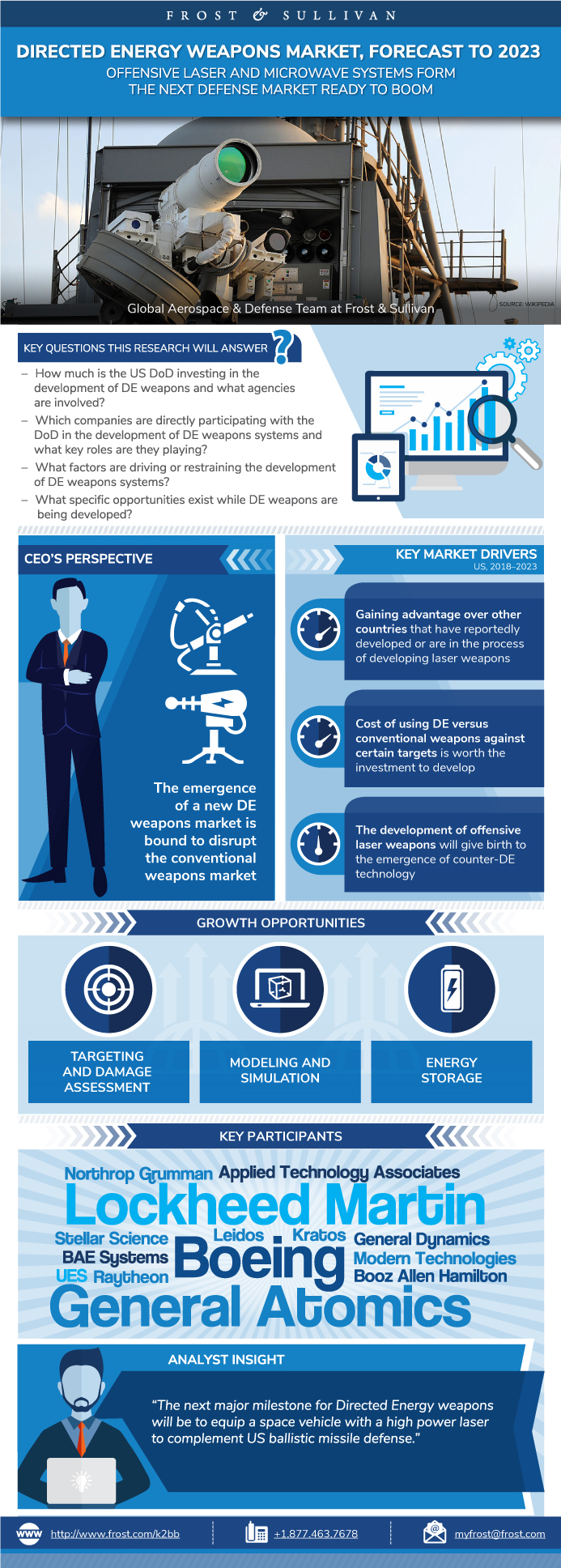
Key Findings
Market Engineering Measurements
CEO’s Perspective
Market Definitions
Market Segmentation
Market Drivers
Market Restraints
Market Engineering Measurements
Total DE Weapons Market—Spending Forecast
Market Share
Market Share Analysis
Market Share Trend
Competitive Environment
Top Competitors
Competitive Factors and Assessment
Growth Opportunity 1—Targeting and Damage Assessment
Growth Opportunity 2—Modeling and Simulation
Growth Opportunity 3—Energy Storage
Strategic Imperatives for DE Weapon Providers
Air Force Segment Key Findings
Market Engineering Measurements
Air Force Spending Forecast
3 Big Predictions
Legal Disclaimer
Market Engineering Methodology
List of Exhibits
 List of Figures
- 1. Total DE Weapons Market: Key Market Drivers, US, 2018–2023
- 2. Total DE Weapons Market: Key Market Restraints, US, 2018–2023
- 3. Total DE Weapons Market: Market Engineering Measurements, US, 2017
- 4. Total DE Weapons Market: Company Market Share Analysis of Top Participants, US, 2017
- 5. Total DE Weapons Market: Competitive Structure, US, 2017–Aug 2018
- 6. Total DE Weapons Market: SWOT Analysis, US, 2017–Aug 2018
- 7. Air Force Segment: Market Engineering Measurements, US, 2017
- 8. Army Segment: Market Engineering Measurements, Global, 2017
- 9. Joint Forces Segment: Market Engineering Measurements, US, 2017
- 10. Navy Segment: Market Engineering Measurements, US, 2017
 List of Charts
- 1. Total DE Weapons Market: Market Engineering Measurements, US, 2017
- 2. Total DE Weapons Market: Percent Spending Breakdown, US, 2017
- 3. Total DE Weapons Market: Spending Forecast, US, 2017–2023
- 4. Total DE Weapons Market: Percent of Contract Awards Breakdown, US, 2017
- 5. Total DE Weapons Market: Percent of Contract Awards Breakdown by Agency (1 Oct 2017 thru 31 Aug 2018), US, 2018
- 6. Total DE Weapons Market: Percent of Contract Awards Breakdown by Company (1 Oct 2017 thru 31 Aug 2018), US, 2018
- 7. Air Force Segment: Percent Spending by Projects, US, 2017
- 8. Air Force Segment: Spending Forecast, US, 2017–2023
- 9. Army Segment: Percent Spending by Projects, US, 2017
- 10. Army Segment: Spending Forecast, US, 2017–2023
- 11. Joint Forces Segment: Percent Spending by Projects, US, 2017
- 12. Joint Forces Segment: Spending Forecast, US, 2017–2023
- 13. Navy Segment: Percent Spending by Project, US, 2017
- 14. Navy Segment: Spending Forecast, US, 2017–2023
Speak directly with our analytics experts for tailored recommendations.
Recent related industry research
16 Sep 2026 | North America | Customer Research
US Automotive Technicians’ Choice Survey, 2025
The 2025 US Automotive Technicians’ Choice study is an insightful voice-of-customer survey that highlights the tool preferences of automotive aftermarket service technicians. The survey of 400 automotive technicians across the United States used a combination of computer-assisted telephone and compu...
16 Sep 2026 | Global | Market Research
Apple Performance Tracker, Q1 2026
This Frost & Sullivan tracker provides metrics on Apple's quarterly performance (for both unit sales and revenues) for iPads, iPhones, Macs, and other products, such as iPods, Apple TVs, Beats Electronics, and Apple-branded and third-party accessories. It includes historical quarterly data for all t...
15 Sep 2026 | Global | Technology Research
Growth Opportunities in Workload Identity and Access Management, Non-Human Identity Security, Threat Exposure Management, and Blockchain Security
This edition of the Cyber Security Technology Opportunity Engine (TOE) showcases emerging cybersecurity innovators advancing AI-powered security, identity and access management, data security, threat exposure management, blockchain security, cyber incident response, network protection, and agentic A...
15 Sep 2026 | South Asia, Middle East & North Africa | Market Research
Future of Growth and Emerging Opportunities in the Gulf Cooperation Council, 2025–2030
The GCC has entered a period of strategic economic transformation as governments accelerate diversification efforts, strengthen economic resilience, and reduce dependence on hydrocarbon revenue amid heightened geopolitical uncertainty and evolving global trade dynamics. While the implications of the...
15 Sep 2026 | Global | Market Research
Vendor Profiles: Advanced Wound Care Management Market, Global, 2025
The wound care market is being transformed by advanced technologies and evolving care models that focus on improving patient outcomes and reducing healthcare costs. Innovations such as smart sensor-embedded dressings, artificial intelligence (AI)-based wound imaging systems, enhanced negative pressu...
Purchase includes:
- Report download
- Growth Dialog™ with our experts
Growth Dialog™
A tailored session with you where we identify the:- Strategic Imperatives
- Growth Opportunities
- Best Practices
- Companies to Action
Impacting your company's future growth potential.
| Deliverable Type | Market Research |
|---|---|
| No Index | No |
| Podcast | No |
| Table of Contents | | Executive Summary~ || Key Findings~ || Market Engineering Measurements~ || CEO’s Perspective~ | Market Overview~ || Market Definitions~ || Market Segmentation~ | Drivers and Restraints—Total DE Weapons Market~ || Market Drivers~ || Market Restraints~ | Forecasts and Trends—Total DE Weapons Market~ || Market Engineering Measurements~ || Total DE Weapons Market—Spending Forecast~ | Market Share and Competitive Analysis—Total DE Weapons Market~ || Market Share~ || Market Share Analysis~ || Market Share Trend~ || Competitive Environment~ || Top Competitors~ || Competitive Factors and Assessment~ | Growth Opportunities and Companies to Action~ || Growth Opportunity 1—Targeting and Damage Assessment~ || Growth Opportunity 2—Modeling and Simulation~ || Growth Opportunity 3—Energy Storage~ || Strategic Imperatives for DE Weapon Providers~ | Air Force Segment Analysis~ || Air Force Segment Key Findings~ || Market Engineering Measurements~ || Air Force Spending Forecast~ | Army Segment Analysis~ | Joint Forces Segment Analysis~ | Navy Segment Analysis~ | The Last Word~ || 3 Big Predictions~ || Legal Disclaimer~ | Appendix~ || Market Engineering Methodology~ || List of Exhibits~ |
| List of Charts and Figures | 1. Total DE Weapons Market: Key Market Drivers, US, 2018–2023~ 2. Total DE Weapons Market: Key Market Restraints, US, 2018–2023~ 3. Total DE Weapons Market: Market Engineering Measurements, US, 2017~ 4. Total DE Weapons Market: Company Market Share Analysis of Top Participants, US, 2017~ 5. Total DE Weapons Market: Competitive Structure, US, 2017–Aug 2018~ 6. Total DE Weapons Market: SWOT Analysis, US, 2017–Aug 2018~ 7. Air Force Segment: Market Engineering Measurements, US, 2017~ 8. Army Segment: Market Engineering Measurements, Global, 2017~ 9. Joint Forces Segment: Market Engineering Measurements, US, 2017~ 10. Navy Segment: Market Engineering Measurements, US, 2017~| 1. Total DE Weapons Market: Market Engineering Measurements, US, 2017~ 2. Total DE Weapons Market: Percent Spending Breakdown, US, 2017~ 3. Total DE Weapons Market: Spending Forecast, US, 2017–2023~ 4. Total DE Weapons Market: Percent of Contract Awards Breakdown, US, 2017~ 5. Total DE Weapons Market: Percent of Contract Awards Breakdown by Agency (1 Oct 2017 thru 31 Aug 2018), US, 2018~ 6. Total DE Weapons Market: Percent of Contract Awards Breakdown by Company (1 Oct 2017 thru 31 Aug 2018), US, 2018~ 7. Air Force Segment: Percent Spending by Projects, US, 2017~ 8. Air Force Segment: Spending Forecast, US, 2017–2023~ 9. Army Segment: Percent Spending by Projects, US, 2017~ 10. Army Segment: Spending Forecast, US, 2017–2023~ 11. Joint Forces Segment: Percent Spending by Projects, US, 2017~ 12. Joint Forces Segment: Spending Forecast, US, 2017–2023~ 13. Navy Segment: Percent Spending by Project, US, 2017~ 14. Navy Segment: Spending Forecast, US, 2017–2023~ |
| Author | John Hernandez |
| Industries | Aerospace, Defence and Security |
| WIP Number | K2BB-01-00-00-00 |
| Is Prebook | No |
| GPS Codes | 9000-A1 |
Directed Energy Weapons Market, Forecast to 2023
$4,950.00
Special Price $3,712.50 save 25 %