 USD
USD GBP
GBP  CNY
CNY  EUR
EUR  INR
INR  JPY
JPY  MYR
MYR  ZAR
ZAR  KRW
KRW  THB
THB 


Advancements in Robotics, Autonomy, and Artificial Intelligence are Driving Transformational Industry Growth
19-Mar-2026
Global
Market Research
PG3L-01-00-00-00
AE_2026_34452
Report Summary: Military Unmanned Ground Vehicle Market
The global Military Unmanned Ground Vehicle Market is gaining steady traction as defense organizations increasingly invest in autonomous and semi-autonomous systems to enhance operational efficiency and reduce human risk. The global unmanned ground vehicles market is being shaped by modernization programs, evolving battlefield requirements, and the growing integration of robotics and artificial intelligence into military operations.
Key Market Trends & Insights
- The Military Unmanned Ground Vehicle Market is witnessing rising adoption across ISTAR, combat, logistics, and EOD applications.
- Defense agencies are prioritizing modular and open system architectures to enable scalability and interoperability.
- AI-enabled navigation, sensor fusion, and autonomous decision-making are transforming capabilities within the global unmanned ground vehicles market.
- Increasing demand for unmanned systems in multi-domain operations is accelerating procurement activities.
- North America and Europe dominate current deployments, while Asia-Pacific is emerging as a high-growth region.
Market Size & Forecast
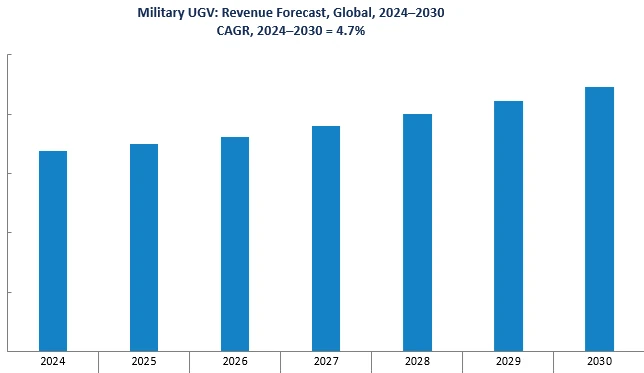
- 2024 Market Size: USD 1,690.4 Million
- 2030 Projected Market Size: USD 2,223.4 Million
- CAGR (2024–2030): ~4.7%
The convergence of autonomy, advanced sensors, and defense digitization is positioning the Military Unmanned Ground Vehicle Market as a critical component of next-generation military capabilities.
Market Overview: Military Unmanned Ground Vehicle Market
The Military Unmanned Ground Vehicle Market is evolving as a key segment within the broader defense and robotics ecosystem, driven by the increasing need for enhanced situational awareness, force protection, and mission efficiency. The global unmanned ground vehicles market encompasses a wide range of platforms designed to operate in hazardous environments, perform reconnaissance, and support combat and logistics operations.
A primary transformation within the Military Unmanned Ground Vehicle Market is the shift toward autonomous and semi-autonomous systems. Advances in artificial intelligence, machine learning, and sensor technologies are enabling UGVs to navigate complex terrains, identify threats, and execute missions with minimal human intervention. These capabilities are significantly enhancing operational effectiveness across the global unmanned ground vehicles market.
Another major trend shaping the Military Unmanned Ground Vehicle Market is the adoption of open system architectures. Defense organizations are increasingly demanding modular platforms that allow rapid integration of new sensors, communication systems, and payloads. This approach reduces lifecycle costs and ensures adaptability to evolving mission requirements within the global unmanned ground vehicles market.
The integration of UGVs into multi-domain operations is further accelerating adoption. These systems are being deployed as networked nodes capable of collaborating with aerial drones, command centers, and electronic warfare systems. This interconnected approach enhances battlefield awareness and coordination, strengthening the strategic value of the Military Unmanned Ground Vehicle Market.
Technological advancements in battery systems, hybrid power solutions, and thermal management are improving endurance and payload capacity, enabling UGVs to operate for extended durations in challenging environments. These innovations are expanding use cases across reconnaissance, combat support, and logistics missions within the global unmanned ground vehicles market.
Despite strong growth potential, challenges such as budget allocation constraints, competition from unmanned aerial systems, and limitations in autonomy under complex conditions persist. However, continued investment in robotics, defense modernization, and AI integration is expected to sustain momentum in the Military Unmanned Ground Vehicle Market, reinforcing its role in future military strategies.
Scope of Analysis: Military Unmanned Ground Vehicle Market
The Military Unmanned Ground Vehicle Market analysis provides a comprehensive evaluation of unmanned ground vehicle technologies, applications, and deployment trends across global defense sectors. The global unmanned ground vehicles market includes platforms designed for intelligence gathering, combat support, explosive ordnance disposal, logistics, and CBRN operations.
The study period spans from 2024 to 2030, with 2024 as the base year and forecasts extending through 2030. The Military Unmanned Ground Vehicle Market is analyzed across key regions, including North America, Europe, Asia-Pacific, and the Middle East, reflecting major defense spending and procurement activities.
From an application perspective, the global unmanned ground vehicles market is segmented into intelligence, surveillance, target acquisition, and reconnaissance (ISTAR); combat; explosive ordnance disposal (EOD)/counter-EOD; transport and logistics; and chemical, biological, radiological, and nuclear (CBRN) operations.
The analysis focuses on defense procurement trends, budget allocations, and publicly disclosed contracts, providing insights into how governments are investing in the Military Unmanned Ground Vehicle Market. It also evaluates competitive positioning and capability coverage among leading manufacturers in the global unmanned ground vehicles market.
A combination of primary research, secondary data analysis, and expert validation ensures a robust assessment of market dynamics and technological developments shaping the Military Unmanned Ground Vehicle Market.
Revenue & Spending Forecast: Military Unmanned Ground Vehicle Market
The Military Unmanned Ground Vehicle Market is projected to grow steadily, supported by increasing defense investments and the expanding role of autonomous systems in military operations. The global unmanned ground vehicles market was valued at approximately USD 1,690.4 million in 2024 and is expected to reach around USD 2,223.4 million by 2030, registering a CAGR of about 4.7%.
Revenue growth in the Military Unmanned Ground Vehicle Market is driven by rising procurement of UGVs for reconnaissance, combat support, and logistics missions. Governments are allocating greater resources toward unmanned systems as part of broader defense modernization strategies, strengthening demand across the global unmanned ground vehicles market.
The increasing integration of AI, advanced sensors, and modular architectures is also contributing to higher-value contracts within the Military Unmanned Ground Vehicle Market. These technologies enhance mission capabilities and interoperability, making UGVs a strategic priority for defense agencies.
Regional spending patterns indicate strong demand in North America and Europe, where established defense programs and technological capabilities support sustained investments. Meanwhile, Asia-Pacific is emerging as a key growth region, driven by rising security concerns and expanding defense budgets within the global unmanned ground vehicles market.
Continued advancements in autonomy and robotics are expected to support long-term revenue expansion, reinforcing the strategic importance of the Military Unmanned Ground Vehicle Market.
Market Segmentation Analysis: Military Unmanned Ground Vehicle Market
The Military Unmanned Ground Vehicle Market is segmented based on application areas, reflecting the diverse operational roles of unmanned systems in modern defense environments. The global unmanned ground vehicles market includes five primary segments: ISTAR, combat, EOD/counter-EOD, transport and logistics, and CBRN operations.
The ISTAR segment represents a significant portion of the Military Unmanned Ground Vehicle Market, focusing on real-time data collection, surveillance, and reconnaissance missions. UGVs in this segment are deployed in contested and hazardous environments, providing critical intelligence to support strategic decision-making across the global unmanned ground vehicles market.
Combat UGVs are designed for offensive and defensive operations, equipped with weapons systems such as small arms and anti-tank missiles. These platforms are increasingly being integrated into manned-unmanned teaming (MUM-T) operations, enhancing battlefield capabilities within the Military Unmanned Ground Vehicle Market.
The EOD/counter-EOD segment plays a crucial role in the global unmanned ground vehicles market, with UGVs used to detect, identify, and neutralize explosive threats, including improvised explosive devices (IEDs). These systems are essential for reducing risks to personnel and ensuring mission safety.
Transport and logistics UGVs are gaining traction in the Military Unmanned Ground Vehicle Market, supporting supply chain operations by transporting ammunition, medical supplies, and other critical resources. These platforms improve operational efficiency and reduce the burden on human personnel.
The CBRN segment addresses specialized missions involving hazardous materials and environments. UGVs in this segment are equipped with advanced sensors and decontamination systems, enabling safe detection and response to chemical, biological, radiological, and nuclear threats within the global unmanned ground vehicles market.
Advancements in autonomy and sensor technologies are enhancing capabilities across all segments, enabling greater flexibility and mission adaptability in the Military Unmanned Ground Vehicle Market.
Growth Drivers: Military Unmanned Ground Vehicle Market
The Military Unmanned Ground Vehicle Market is driven by several key factors that are reshaping modern defense operations. One of the primary drivers is the global shift toward modular and open system architectures, enabling rapid integration of new technologies and reducing lifecycle costs within the global unmanned ground vehicles market.
The increasing adoption of UGVs in multi-domain operations is another significant growth driver. These systems are being deployed as interconnected nodes capable of integrating with aerial drones, sensors, and command systems, enhancing battlefield awareness and coordination across the Military Unmanned Ground Vehicle Market.
Advancements in battery technology and hybrid power systems are also contributing to market growth. Improved energy density and thermal management allow UGVs to operate for longer durations and support heavier payloads, expanding their operational capabilities within the global unmanned ground vehicles market.
The rising demand for autonomous systems to reduce human risk in hazardous environments is further accelerating adoption. UGVs are increasingly used in missions such as EOD, reconnaissance, and logistics, where minimizing personnel exposure is critical.
Defense modernization programs and increased investment in robotics and AI are reinforcing demand across the Military Unmanned Ground Vehicle Market, positioning unmanned systems as essential components of future military strategies.
Growth Restraints: Military Unmanned Ground Vehicle Market
Despite strong growth potential, the Military Unmanned Ground Vehicle Market faces several challenges that may impact adoption and deployment. One of the key restraints is budget allocation imbalance, as unmanned aerial vehicles (UAVs) often receive higher funding compared to ground-based systems within the global unmanned ground vehicles market.
The competitive landscape is also evolving rapidly, with consolidation among defense companies potentially limiting opportunities for smaller players. Mergers and acquisitions may create barriers to entry and reduce diversity within the Military Unmanned Ground Vehicle Market.
Technical limitations related to autonomy remain another challenge. UGVs must operate in complex and unpredictable environments, including urban terrains and debris-filled areas. Achieving reliable navigation and communication in such conditions continues to be a significant hurdle within the global unmanned ground vehicles market.
Additionally, integration challenges and interoperability issues can slow deployment, particularly in multi-domain operations where seamless communication between systems is critical.
Addressing these constraints will require continued investment in technology development, regulatory support, and collaborative innovation across the Military Unmanned Ground Vehicle Market.
Competitive Landscape: Military Unmanned Ground Vehicle Market
The Military Unmanned Ground Vehicle Market is characterized by a competitive landscape that includes established defense contractors, specialized robotics firms, and emerging technology providers. The global unmanned ground vehicles market is driven by continuous innovation and strategic collaborations aimed at enhancing platform capabilities.
Key players in the Military Unmanned Ground Vehicle Market include General Dynamics Land Systems, Oshkosh Defense, Textron Systems, Rheinmetall AG, and QinetiQ. These companies maintain strong positions in the global unmanned ground vehicles market through advanced technologies, extensive defense contracts, and global operational presence.
Competition is largely influenced by factors such as technological innovation, system integration capabilities, and the ability to deliver mission-ready solutions. Companies in the Military Unmanned Ground Vehicle Market are focusing on developing platforms that support modular payloads, AI-enabled autonomy, and interoperability with other defense systems.
Regional players are also gaining prominence, particularly in Asia-Pacific and the Middle East, where governments are investing in domestic defense capabilities. This trend is increasing competition and driving innovation across the global unmanned ground vehicles market.
Strategic partnerships and collaborations are playing a crucial role in shaping the competitive landscape. Defense companies are working with technology providers to integrate advanced sensors, AI, and communication systems into UGV platforms.
As the market evolves, companies that can deliver scalable, adaptable, and technologically advanced solutions will strengthen their competitive positioning within the Military Unmanned Ground Vehicle Market.
Scope of Analysis
Industry Segmentation
Why is it Increasingly Difficult to Grow?
The Strategic Imperative 8™
The Impact of the Top 3 Strategic Imperatives on the Military UGV Industry
Growth Metrics
Growth Drivers
Growth Restraints
Forecast Considerations
Revenue Forecast
Revenue Forecast by Industry Segment
Revenue Forecast by Region
Revenue Forecast Analysis: Europe
Representative Programs: Europe
Revenue Forecast Analysis: APAC
Representative Programs: APAC
Revenue Forecast Analysis: North America
Representative Programs: North America
Revenue Forecast Analysis: Middle East
Representative Programs: Middle East
Key Competitors’ Capability Coverage: North America
Key Competitors’ Capability Coverage: APAC
Key Competitors’ Capability Coverage: Europe
Key Competitors’ Capability Coverage: Middle East
Growth Opportunity 1: Resilient Positioning, Navigation, and Timing
Growth Opportunity 2: Edge AI and Onboard Learning
Growth Opportunity 3: Additive Manufacturing
Benefits and Impacts of Growth Opportunities
Next Steps
List of Exhibits
Legal Disclaimer
Frequently Asked Questions (FAQ) – Military Unmanned Ground Vehicle Market
1. What is the Military Unmanned Ground Vehicle Market?
The Military Unmanned Ground Vehicle Market refers to the global ecosystem of robotic ground systems used in defense operations for reconnaissance, combat support, logistics, and hazardous missions. The global unmanned ground vehicles market includes autonomous and semi-autonomous platforms deployed across multiple battlefield applications.
2. What is driving growth in the global unmanned ground vehicles market?
Growth in the global unmanned ground vehicles market is driven by increasing defense modernization programs, rising adoption of autonomous systems, and the need to reduce human risk in hazardous environments. Advancements in AI, robotics, and sensor technologies are also accelerating demand.
3. What are the key applications in the Military Unmanned Ground Vehicle Market?
Key applications in the Military Unmanned Ground Vehicle Market include intelligence, surveillance, target acquisition, and reconnaissance (ISTAR), combat operations, explosive ordnance disposal (EOD), transport and logistics, and chemical, biological, radiological, and nuclear (CBRN) missions.
4. Which technologies are shaping the Military Unmanned Ground Vehicle Market?
The Military Unmanned Ground Vehicle Market is being shaped by technologies such as artificial intelligence, machine learning, sensor fusion, autonomous navigation systems, and modular open architectures that enable interoperability and scalability.
5. Which regions dominate the global unmanned ground vehicles market?
North America and Europe dominate the global unmanned ground vehicles market due to strong defense budgets, advanced military technologies, and ongoing modernization programs. Asia-Pacific is emerging as a high-growth region.
6. What are the benefits of unmanned ground vehicles in military operations?
Unmanned ground vehicles improve operational efficiency, enhance situational awareness, reduce risks to personnel, and enable missions in hazardous environments such as explosive disposal and reconnaissance in contested areas.
7. What challenges does the Military Unmanned Ground Vehicle Market face?
Challenges in the Military Unmanned Ground Vehicle Market include budget constraints, competition from unmanned aerial systems, technical limitations in autonomous navigation, and integration complexities in multi-domain operations.
8. Who are the key players in the global unmanned ground vehicles market?
Key players in the global unmanned ground vehicles market include General Dynamics Land Systems, Oshkosh Defense, Textron Systems, Rheinmetall AG, QinetiQ, and other regional defense manufacturers specializing in robotics and autonomous systems.
9. How is AI influencing the Military Unmanned Ground Vehicle Market?
AI is enhancing the Military Unmanned Ground Vehicle Market by enabling autonomous navigation, real-time decision-making, threat detection, and improved coordination with other unmanned systems in multi-domain operations.
10. What is the future outlook for the Military Unmanned Ground Vehicle Market?
The future outlook for the Military Unmanned Ground Vehicle Market is positive, with continued growth expected due to increasing defense investments, advancements in robotics and AI, and the strategic importance of autonomous systems in modern warfare.
Speak directly with our analytics experts for tailored recommendations.
Recent related Defense research
07 Oct 2026 | North America | Frost Radar
Frost Radar™: US Military Intelligence Analytics, 2026
The US military intelligence (MILINT) analytics industry is undergoing a structural transformation as defense and intelligence agencies transition from platform-centric architectures to AI-native, data-centric, and decision-driven operational models. Intelligence systems are no longer confined to po...
30 Sep 2026 | Global | Market Research
Total Airport Management (TAM) Market, Global, 2025–2034
Total airport management (TAM) represents a high-potential convergence market that integrates enterprise architecture, data management, resource and capacity planning, collaborative decision-making, passenger management, and airport simulation/digital twin into a unified operational framework. TAM r...
24 Sep 2026 | North America | Market Research
Military Aviation Maintenance, Repair, and Overhaul Industry, US, 2025–2030
This research service provides a comprehensive overview of the US military aviation maintenance, repair, and overhaul (MRO) industry. The study segments the industry into six platform categories: 1. Fighter, Attack, & Bomber 2. Rotorcraft 3. Transport & Tanker 4. Training & Utility 5. Intelligence, ...
03 Sep 2026 | Global | Technology Research
Photonic and Optical Computing Chips for AI and Data Center Acceleration
The study evaluates photonic and optical computing technologies as critical enablers of next-generation AI infrastructure, addressing growing bandwidth, latency, power consumption, and scalability constraints associated with copper-based interconnects. The analysis covers photonic integrated circuit...
25 Aug 2026 | North America | Market Research
US Military Intelligence Analytics Industry Growth Opportunities, 2025–2028
The US military intelligence (MILINT) analytics market is undergoing rapid transformation driven by the convergence of AI, big data analytics, and next-generation sensing. As the DoW and the wider intelligence community (IC) face increasingly complex multi-domain threats, the demand for scalable, re...
Purchase includes:
- Report download
- Growth Dialog™ with our experts
Growth Dialog™
A tailored session with you where we identify the:- Strategic Imperatives
- Growth Opportunities
- Best Practices
- Companies to Action
Impacting your company's future growth potential.
Author: Shreya Khakurel
| Deliverable Type | Market Research |
|---|---|
| Industries | Aerospace, Defence and Security |
| No Index | No |
| Is Prebook | No |
| Keyword 1 | unmanned ground vehicles market |
| Keyword 2 | military UGV market forecast |
| Keyword 3 | defense robotics market trends |
| Podcast | No |
| Predecessor | None |
| WIP Number | PG3L-01-00-00-00 |