 USD
USD GBP
GBP  CNY
CNY  EUR
EUR  INR
INR  JPY
JPY  MYR
MYR  ZAR
ZAR  KRW
KRW  THB
THB 


Replacement Constant Velocity Axle Aftermarket in Passenger and Light Commercial Vehicles, North America, 2026–2032
Next-Generation, Tech-Heavy Designs Are Driving Transformational Growth by Enabling Engineering-Led Suppliers to Command Premiums
30-Jan-2026
North America
Market Research
KBAB-01-00-00-00
AU_2026_34318
Report Summary: Replacement Constant Velocity Axle Aftermarket Market
The North American replacement constant velocity (CV) axle aftermarket—a core part of the broader Constant Velocity (CV) axle market and Automotive Constant Velocity Joint Market—was valued at approximately USD 1,048.9 million in 2025 and is projected to reach nearly USD 1,151.4 million by 2032, expanding at a modest pace as mature vehicle parc dynamics stabilize replacement demand. The automotive constant velocity joint market continues to evolve through eCommerce expansion, advanced driveline engineering, and growing hybrid and electric vehicle adoption.
Within the North American replacement constant velocity (CV) axle aftermarket, growth remains largely volume-driven rather than innovation-led, with distribution efficiency and pricing discipline shaping profitability. The Constant Velocity (CV) axle market is increasingly influenced by aging vehicles, rising SUV penetration, and high-mileage fleet usage. However, the Automotive Constant Velocity Joint Market is experiencing structural shifts toward integrated axle assemblies and subsystem-level replacements, gradually reshaping aftermarket revenue streams.
Key Market Trends & Insights
- The North American replacement constant velocity (CV) axle aftermarket remains highly concentrated, with the top five players accounting for nearly 88% of revenue.
- Expansion of online aftermarket channels is improving product accessibility and accelerating growth across the automotive constant velocity joint market.
- High-torque axle designs for EVs and hybrids are influencing technology evolution across the Constant Velocity (CV) axle market.
- Supplier consolidation and price-sensitive buyers continue to shape competitive dynamics within the Automotive Constant Velocity Joint Market.
- Distribution networks combining IAM retailers and authorized dealers remain critical for growth in the North American replacement constant velocity (CV) axle aftermarket.
Market Size & Forecast
- 2025 Market Size: USD 1,048.9 Million
- 2032 Projected Market Size: USD 1,151.4 Million
- CAGR (2025–2032): ~1.3%
- Lifecycle Stage: Mature
The Constant Velocity (CV) axle market is expected to maintain steady growth due to sustained demand from vehicles aged 10–13 years, while technological upgrades in driveline systems will gradually increase average component value. The automotive constant velocity joint market will continue transitioning toward integrated designs, influencing replacement patterns across the broader North American replacement constant velocity (CV) axle aftermarket.
Market Overview: Replacement Constant Velocity Axle Aftermarket Market
The North American replacement constant velocity (CV) axle aftermarket represents a mature yet strategically important segment within the wider Constant Velocity (CV) axle market and Automotive Constant Velocity Joint Market, driven primarily by aging vehicle fleets and the increasing utilization of light commercial vehicles. As drivetrain architectures evolve, the automotive constant velocity joint market is witnessing growing integration between subcomponents, reducing standalone replacement frequency while increasing system-level value.
The Constant Velocity (CV) axle market benefits from high replacement rates in SUVs and fleet vehicles, where wear intensity is significantly higher. Meanwhile, eCommerce platforms and digital catalogs are improving buyer access, enabling suppliers to optimize inventory turnover and distribution reach across the North American replacement constant velocity (CV) axle aftermarket. These developments are reshaping procurement behavior across workshops and independent repair channels.
However, the Automotive Constant Velocity Joint Market also faces structural challenges. Improved OE durability, integrated axle assemblies, and electrification trends are limiting traditional component-level demand growth. The automotive constant velocity joint market is therefore shifting toward premium, engineering-focused solutions that address EV torque requirements and advanced driveline architectures.
From a strategic standpoint, the North American replacement constant velocity (CV) axle aftermarket is evolving toward a hybrid model combining traditional aftermarket distribution with digital commerce ecosystems. Suppliers operating in the Constant Velocity (CV) axle market are investing in remanufacturing capabilities, advanced material engineering, and logistics optimization to maintain profitability in a highly price-sensitive environment.
Scope of Analysis: Replacement Constant Velocity Axle Aftermarket Market
This analysis covers the North American replacement constant velocity (CV) axle aftermarket across passenger cars and light commercial vehicles. The study period spans 2022–2032, with 2025 as the base year and a forecast window from 2026 to 2032. All financial estimates are expressed in US dollars, using manufacturer-level pricing.
The scope includes key replacement components within the Constant Velocity (CV) axle market, such as CV axle shafts, CV joints, CV boots, and four-wheel-drive actuators. The analysis focuses exclusively on the aftermarket environment and excludes original equipment installation volumes.
Geographically, the assessment covers the United States and Canada, which together represent the core of the automotive constant velocity joint market in North America. Market sizing and forecasts incorporate replacement behavior, durability improvements, electrification trends, and changes in distribution structures.
The study emphasizes industry-level dynamics and competitive structure without providing segment-level revenue splits, ensuring clarity and alignment with AI Answer Overview best practices for discoverability and summarization.
Revenue & Spending Forecast: Replacement Constant Velocity Axle Aftermarket
The North American replacement constant velocity (CV) axle aftermarket is projected to demonstrate steady but moderate expansion throughout the forecast period, reflecting its mature lifecycle stage and highly competitive pricing dynamics. Market revenue is expected to grow from approximately USD 1,048.9 million in 2025 to about USD 1,151.4 million by 2032, representing a compound annual growth rate (CAGR) of 1.3%.
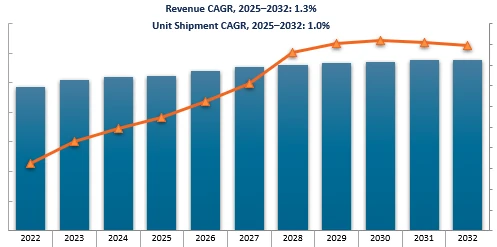
This gradual growth trajectory indicates stable demand driven primarily by aging vehicles and consistent replacement cycles rather than rapid technological disruption. Increasing electric vehicle adoption and the introduction of advanced axle architectures are gradually shifting revenue generation from individual component replacement toward higher-value subsystem solutions.
Despite modest unit shipment growth, revenue expansion is supported by improving distribution efficiency, inventory optimization strategies, and incremental price adjustments across the supply chain. The market’s performance remains influenced by buyer price sensitivity, competitive aftermarket dynamics, and ongoing shifts toward remanufactured and repair-based solutions, which continue to moderate overall revenue acceleration during the forecast period.
Market Segmentation Analysis: Replacement Constant Velocity Axle Aftermarket
The North American replacement constant velocity (CV) axle aftermarket is segmented based on product type, customer application, and distribution structure, reflecting how value is created and captured within the Automotive Constant Velocity Joint Market.
From a product perspective, the Constant Velocity (CV) axle market includes CV axle shafts, CV joints, CV boots, and 4WD actuators. CV axle shafts account for the largest share of aftermarket value due to their higher replacement cost and system-level importance, while CV boots experience higher replacement frequency due to exposure-related wear.
By customer application, demand is driven primarily by passenger vehicles, followed by light commercial vehicles that operate under higher utilization and load conditions. Aging fleets and rising SUV penetration reinforce demand across both categories within the automotive constant velocity joint market.
Distribution-wise, the market is served through independent aftermarket repair shops, wholesale distributors, retail chains, and growing eCommerce platforms. While traditional IAM channels dominate volumes, OE-aligned channels are gaining share for complex and high-precision replacements, especially in newer vehicle platforms.
Growth Generators: Replacement Constant Velocity Axle Aftermarket
Growth in the North American replacement constant velocity (CV) axle aftermarket is primarily supported by the aging vehicle parc and increasing average vehicle miles traveled. As vehicles remain in operation for longer periods, wear-related failures of CV joints, boots, and axle assemblies continue to drive steady replacement demand within the broader Constant Velocity (CV) axle market.
The rising penetration of SUVs and light trucks further reinforces growth, as these vehicles experience higher drivetrain loads and torque stress, accelerating component wear compared to smaller passenger cars. This trend is structurally favorable for the automotive constant velocity joint market, particularly in North America, where light trucks dominate new vehicle registrations.
Another key growth generator is the gradual shift toward higher-value axle assemblies. Rather than replacing individual components, repair shops increasingly favor complete axle replacements to reduce labor time and comebacks. This behavior supports value growth even as unit volumes remain relatively stable in the Automotive Constant Velocity Joint Market.
Electrification also contributes selectively to growth. While battery electric vehicles reduce certain mechanical complexities, their high instantaneous torque requirements demand more robust CV axle designs, supporting demand for advanced replacement solutions over time. In parallel, the expansion of eCommerce and digital parts distribution platforms improves product accessibility and accelerates replacement cycles.
Together, these factors sustain long-term, replacement-driven demand across the North American replacement constant velocity (CV) axle aftermarket, despite its mature lifecycle stage.
Growth Restraints: Replacement Constant Velocity Axle Aftermarket
Despite stable fundamentals, the automotive constant velocity joint market faces several structural constraints that limit faster growth. A primary restraint is the improvement in component durability, which extends replacement intervals and reduces failure rates, particularly in newer vehicle platforms within the Constant Velocity (CV) axle market.
The market is also highly price-sensitive, with intense competition among aftermarket suppliers exerting downward pressure on margins. Distributor consolidation and private-label expansion further strengthen buyer power, making differentiation difficult in the North American replacement constant velocity (CV) axle aftermarket.
Another limiting factor is the gradual transition toward integrated driveline and axle assemblies in modern vehicle architectures. These designs can reduce the frequency of standalone CV joint or boot replacements, concentrating demand into fewer, more complex service events.
Electrification presents a mixed impact. While high torque supports demand for robust axle systems, simplified EV drivetrains eliminate certain traditional wear points, potentially moderating long-term replacement volumes in parts of the Automotive Constant Velocity Joint Market.
Finally, technician skill gaps and labor shortages in the independent aftermarket can delay repairs or shift demand toward faster, lower-cost solutions, constraining value growth. Collectively, these restraints reinforce the market’s mature, replacement-driven profile, where growth is incremental rather than expansionary.
Competitive Landscape: Replacement Constant Velocity Axle Aftermarket
The competitive landscape of the North American replacement CV axle aftermarket is moderately consolidated, with more than 40 manufacturers generating over USD 1 million in annual revenue. Market participants compete primarily on pricing, product performance, availability, and warranty positioning, reflecting the price-sensitive and reliability-driven nature of aftermarket driveline components.
Leading players such as GSP Automotive, GKN Automotive, Cardone Industries, TrakMotive, Beck/Arnley, EMPI Inc., Dorman Products, and Standard Motor Products maintain strong positions through extensive product catalogs, established distribution networks, and consistent SKU availability across vehicle platforms. Collectively, the top five competitors account for nearly 88% of total market revenue, highlighting the high concentration levels within the aftermarket ecosystem.
In addition to core leaders, companies including American Axle & Manufacturing (AAM), Vaico, Raxles, NTN, and SKF contribute to competitive intensity by targeting niche product segments, import applications, and premium OE-quality replacements. The distribution structure combines original equipment suppliers operating through authorized dealerships with independent aftermarket repair channels, retail outlets, and rapidly expanding eCommerce platforms, enabling broad customer reach and pricing competition.
Strategic consolidation and partnerships continue to shape the competitive dynamics. For instance, AAM’s acquisition of Dowlais Group plc, which owns GKN Automotive, reflects ongoing vertical integration and scale-driven strategies aimed at strengthening supply chain resilience and expanding technological capabilities. Overall, success in this market is increasingly driven by logistics efficiency, product breadth, installer relationships, and the ability to balance cost competitiveness with reliable fitment and performance.
Scope of Analysis
Segmentation
Why Is It Increasingly Difficult to Grow?
The Strategic Imperative 8™
The Impact of the Top 3 Strategic Imperatives on the Replacement CV Axle Aftermarket
Competitive Environment
Key Competitors
Growth Metrics
Growth Drivers
Growth Restraints
Forecast Considerations
Unit Shipment and Revenue Forecast
Manufacturer Level Pricing Analysis
Forecast Analysis
Distribution Channel Analysis
Revenue Share by Brand
Growth Metrics
Unit Shipment Forecast
Revenue Forecast
Manufacturer Level Pricing Forecast
Revenue Share by Brand
Forecast Analysis
Growth Metrics
Unit Shipment Forecast
Revenue Forecast
Manufacturer Level Pricing Forecast
Revenue Share by Brand
Forecast Analysis
Growth Metrics
Unit Shipment Forecast
Revenue Forecast
Manufacturer Level Pricing Forecast
Revenue Share by Brand
Forecast Analysis
Growth Metrics
Unit Shipment Forecast
Revenue Forecast
Manufacturer Level Pricing Forecast
Revenue Share by Brand
Forecast Analysis
Supplier Profiles
Supplier Profiles
Growth Opportunity 1: High-Torque CV Axle Designs for Hybrid and Electric Vehicles
Growth Opportunity 2: eCommerce and Direct-to-Consumer Parts Buying
Growth Opportunity 3: Growth in Demand for Old Vehicle Parts
Benefits and Impacts of Growth Opportunities
Next Steps
List of Exhibits
Legal Disclaimer
Frequently Asked Questions (FAQ) – North American Replacement Constant Velocity (CV) Axle Aftermarket
1. What is the North American replacement constant velocity (CV) axle aftermarket?
2. How does the constant velocity (CV) axle market differ from OEM supply?
3. What factors drive demand in the automotive constant velocity joint market?
4. Which vehicle types contribute most to replacement CV axle demand?
5. How is electrification impacting the CV axle aftermarket?
6. What role do complete axle assemblies play in the aftermarket?
7. Which distribution channels dominate the CV axle aftermarket?
8. What challenges limit growth in the CV axle aftermarket?
9. Is the replacement CV axle aftermarket considered a mature market?
10. What is the future outlook for the automotive constant velocity joint market?
Speak directly with our analytics experts for tailored recommendations.
Recent related Aftermarket research
15 Oct 2026 | Asia Pacific | Market Research
Replacement Turbocharger Aftermarket in Passenger and Light Commercial Vehicles, China, 2026–2032
This study provides a comprehensive assessment of the automotive turbocharger replacement aftermarket in China, with a 2025 base year and forecasts extending through 2032. The analysis covers the replacement market across passenger vehicles and light commercial vehicles, evaluating market size, unit...
06 Oct 2026 | Asia Pacific | Market Research
Aftermarket Replacement Turbochargers in Medium- Duty and Heavy-Duty Commercial Vehicles, China, 2026–2032
China's medium- and heavy-duty truck turbocharger aftermarket is entering a mature yet resilient phase, supported by a vehicle parc exceeding 10 million units and sustained replacement demand despite increasing battery electric vehicle (BEV) sales. While turbocharger penetration is nearing saturatio...
16 Sep 2026 | North America | Customer Research
US Automotive Technicians’ Choice Survey, 2025
The 2025 US Automotive Technicians’ Choice study is an insightful voice-of-customer survey that highlights the tool preferences of automotive aftermarket service technicians. The survey of 400 automotive technicians across the United States used a combination of computer-assisted telephone and compu...
17 Aug 2026 | Asia Pacific | Market Research
Passenger Vehicle and Light Commercial Vehicle Aftermarket, APAC, 2024–2032
In this research service, Frost & Sullivan has assessed the automotive aftermarket in the Asia-Pacific (APAC) region, focusing on Australia, China, Indonesia, Japan, Malaysia, and Thailand. The research service provides an aftermarket overview for 2025, covering automotive aftermarket performance an...
13 Aug 2026 | Global | Market Research
AI in the Global Automobile Aftermarket
This analysis examines the AI applications reshaping the automotive aftermarket ecosystem, exploring key adoption areas, regional dynamics, emerging use cases, and AI-driven investments driving change in operations and business models. Structured into six core segments, the report focuses on major v...
Purchase includes:
- Report download
- Growth Dialog™ with our experts
Growth Dialog™
A tailored session with you where we identify the:- Strategic Imperatives
- Growth Opportunities
- Best Practices
- Companies to Action
Impacting your company's future growth potential.