 USD
USD GBP
GBP  CNY
CNY  EUR
EUR  INR
INR  JPY
JPY  MYR
MYR  ZAR
ZAR  KRW
KRW  THB
THB 


Growth Opportunities in Unmanned Underwater Vehicles, 2023 2032 Updated Research Available
The Shift Toward Autonomous Operations Accelerates Growth
12-Jun-2024
North America
Market Research
KA4D-01-00-00-00
AE_2024_793
The global unmanned underwater vehicles (UUV) industry is experiencing robust growth thanks to several key factors, including the increasing demand for underwater exploration, surveillance, and defense applications. Technological advancements in UUV capabilities, such as improved autonomy, sensor systems, and data processing capabilities, are enhancing their effectiveness and driving adoption across defense, commercial, and research sectors. Additionally, growing investment in maritime security, offshore exploration, and underwater infrastructure development is creating new opportunities for UUV manufacturers and service providers worldwide.
However, the UUV industry also faces some challenges and restraints. High development and acquisition costs and limited awareness and education about UUV capabilities among potential end users and stakeholders pose barriers to market entry and growth. Despite these challenges, ongoing trends, such as the emergence of autonomous underwater systems, the integration of artificial intelligence (AI) and machine learning (ML) technologies, and the rise of collaborative partnerships and strategic alliances are driving innovation and shaping the future of the UUV industry.
Regarding market segmentation, this study divides the market by end-use into defense, commercial, and research sectors, with each segment presenting distinct growth opportunities and dynamics. Geographically, it considers these segments: North America, Asia-Pacific, Europe, the Middle East and Africa, and Latin America. Each offers unique market conditions and growth potential. By carrying out a comprehensive analysis of market drivers, restraints, trends, challenges, and growth opportunities, this study provides valuable insights for industry stakeholders, investors, and decision-makers seeking to capitalize on the evolving UUV market landscape and maximize their competitive advantage.
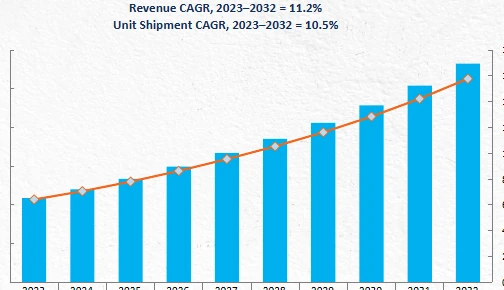
Revenue Forecast
The revenue estimate for the base year 2023 CAGR of 10.5% during the study period from 2023 to 2032
Scope of Analysis
- This study analyzes the UUV industry, considering its status and prospects over the forecast period.
- The industry is segmented into three main end uses:
- Defense—most customers are navies. This includes procurement and research and development (R&D) contracts.
- Commercial—customers are mostly service providers and operators in the offshore wind energy, oil and gas, and telecom industries.
- Research—universities and oceanographic research institutes are the main end users.
The Impact of the Top 3 Strategic Imperatives on the Unmanned Underwater Vehicles Industry
Disruptive Technologies
Why
- Improving artificial intelligence (AI) for autonomous navigation is crucial in the unmanned underwater vehicle (UUV) industry due to the challenges of communicating with the control station underwater.
Frost Perspective
- Companies providing autonomous underwater vehicles (AUV) that do not invest in the continuous development of autonomous capabilities will find it difficult to grow because AI-enabled autonomy is the key differentiator in that segment.
Competitive Intensity
Why
- New start-ups are springing up globally, posing challenges to big, well-established defense contractors.
- The UUV industry is characterized by numerous technology partnerships between manufacturers to develop optimal solutions.
Frost Perspective
- New companies that can overcome the high entry barriers in this market, including high development costs, will be able to challenge the current competitive landscape, especially in the commercial and research sectors, because defense contractors are better prepared for fewer large contracts.
Geopolitical Chaos
Why
- Growing international conflicts and intensifying tensions are pushing countries to adopt unmanned systems for defense and security applications.
Frost Perspective
- The attacks on the Nord Stream pipelines in 2022 evidenced the need for critical undersea infrastructure security.
- Navies will have to adopt more UUVs to achieve ocean supremacy.
Growth Drivers
- Many military programs are increasing the global demand for UUVs in defense applications, especially in the United States.
- Ongoing global conflicts and tensions, such as the China-Taiwan conflict, are increasing global military forces’ spending on unmanned underwater technology.
- The interest in UUVs for surveillance and security in critical undersea infrastructure boomed after the attack on the Nord Stream pipelines.
- The rising number of offshore wind farms and offshore oil and gas stations drives the use of UUVs in the commercial segment.
- Continuous technological advancements in autonomy; sensor size, weight, and power (SWaP) optimization; and battery endurance enhance UUV applications, increasing UUVs’ customer value.
Growth Restraints
Restraint
- High acquisition and development costs impede some potential customers from buying UUVs and delay some military programs.
- Like most unmanned systems applications, low awareness about the benefits that UUVs offer to underwater operations hampers the growth of the industry.
- Industry participants claim that the global supply chain issues that emerged are still delaying manufacturing processes and challenging new product development.
- Some large oil and gas service providers manufacture their own UUVs (usually ROVs), which limits market penetration in the commercial segment.
Key Competitors
- Advanced Navigation
- Asealan
- Anduril Industries
- Atlas Elektronik (ThyssenKrupp)
- BAE Systems
- Bluefin Robotics (General Dynamics)
- Boeing
- Boxfish Robotics
- Cellula Robotics
- Exail
- Hanwha Systems
- HII
- International Submarine Engineering
- IQUA Robotics
- IAI
- Kongsberg
- Lockheed Martin
- L3Harris Technologies
- Leidos
- Mitsubishi Heavy Industries
- MSubs
- Nauticus Robotics
- Naval Group
- Northrop Grumman
- Ocean Aero
- Oceanengineering
- RTSys
- Saab
- Saipem
- SEABER
- Subsea Tech
- Teledyne Marine
- Terradeth
- Woods Hole Oceanographic Institution
- Atlas Elektronik (ThyssenKrupp)
- Blue Robotics
- Boxfish Robotics
- Deep Trekker (Halma)
- Exail
- Hanwha Systems
- International Submarine Engineering
- L3Harris Technologies
- MacArtney Underwater Technology
- Mitsubishi Heavy Industries
- Oceanbotics (RJE International)
- Oceanengineering
- Saab
- Saipem
- Shark Marine Technologies
- Subsea Tech
- TechnipFMC
- Teledyne Marine
- Total Marine Technology
- VideoRay
- Woods Hole Oceanographic Institution
- Alseamar
- Kongsberg
- Teledyne Marine
- Woods Hole Oceanographic Institution

Why is it Increasingly Difficult to Grow?
The Strategic Imperative 8
The Impact of the Top 3 Strategic Imperatives on the Unmanned Underwater Vehicles Industry
Scope of Analysis
Segmentation
Segmentation by End Use
Trends and Challenges
Competitive Environment
Key Competitors
Distribution Channels
Growth Metrics
Growth Drivers
Growth Restraints
Forecast Considerations
Revenue and Unit Shipment Forecast
Revenue Forecast by End Use
Revenue Forecast by Region
Revenue Forecast Analysis
Unit Shipment Forecast by End Use
Unit Shipment Forecast by Region
Pricing Trends and Forecast Analysis
Revenue Share
Revenue Share Analysis
Significant M&A
Significant Partnerships
Significant Contracts
Growth Metrics
Revenue and Unit Shipment Forecast
Revenue Forecast by Region
Unit Shipment Forecast by Region
Forecast Analysis
Growth Metrics
Revenue and Unit Shipment Forecast
Revenue Forecast by Region
Unit Shipment Forecast by Region
Forecast Analysis
Growth Metrics
Revenue and Unit Shipment Forecast
Revenue Forecast by Region
Unit Shipment Forecast by Region
Forecast Analysis
Examples of Research Institutes and Universities with UUV Programs
Growth Opportunity 1—Unmanned Teaming
Growth Opportunity 2—Micro-AUV
Growth Opportunity 3—AUVs for Offshore Oil and Gas Operations
Key Conclusions
Best Practices Recognition
Frost Radar
Benefits and Impacts of Growth Opportunities
Next Steps
Take the Next Step
List of Exhibits
Legal Disclaimer
Speak directly with our analytics experts for tailored recommendations.
Recent related Defence research
26 Dec 2024 | Global | Market Research
US Military Intelligence Industry Growth Opportunities, 2024-2026
Artificial intelligence (AI) is ushering in a new era of possibilities for intelligence gathering and analysis. While AI has been a part of the US Intelligence Community (IC) for some time, the rapid acceleration of AI capabilities is drastically transforming the landscape. The vast amount of infor...
13 Dec 2024 | Global | Market Research
Growth Opportunities in Space-based Intelligence, Surveillance, and Reconnaissance (ISR)
Space-based intelligence, surveillance, and reconnaissance (ISR) refers to the strategic use of satellites and space-based assets to gather, process, and disseminate critical information for military, intelligence, and security purposes. These systems are pivotal in providing real-time, global monit...
20 Nov 2024 | Global | Strategic Forecasting
Top 10 Strategic Imperatives in Drone Warfare, 2024
Sophisticated surveillance and intelligence gathering is essential in military operations. Technology advancements in drones are enabling enhanced situational awareness and operational efficiency in military operations through a variety of advanced features, including AI-driven autonomous decision-m...
29 Oct 2024 | North America | Market Research
Government Cybersecurity Sector, United States, 2023 2028
In this study, Frost & Sullivan analyzes the significant increase in US government cybersecurity spending, driven by escalating geopolitical tensions. As cyberspace transforms into a modern battleground for covert warfare, state-backed Advanced Persistent Threat groups are launching sophisticated cy...
09 Sep 2024 | Global | Market Research
Military Rotary Wing Market, Global, FY2024 FY2032
The global military rotary wing market has seen quite a few developments in recent years because modern warfare demands more advanced aerial capabilities. Against the backdrop of geopolitical tension and changeable, complex conflicts, the requirements placed on military helicopters have increased; t...
Purchase includes:
- Report download
- Growth Dialog™ with our experts
Growth Dialog™
A tailored session with you where we identify the:- Strategic Imperatives
- Growth Opportunities
- Best Practices
- Companies to Action
Impacting your company's future growth potential.