 USD
 GBP
 CNY
 EUR
 INR
 JPY
 MYR
 ZAR
 KRW
 THB


SoftBank Mobility Strategies, 2030
With $268 Billion in Equity and a $100 Billion Vision Fund, the Conglomerate will Leverage AI to Become a Powerhouse of the Automotive and Connected Living Environment
16-Dec-2020
Asia Pacific
Market Research
K493-01-00-00-00
AU02089-AP-MT_25050
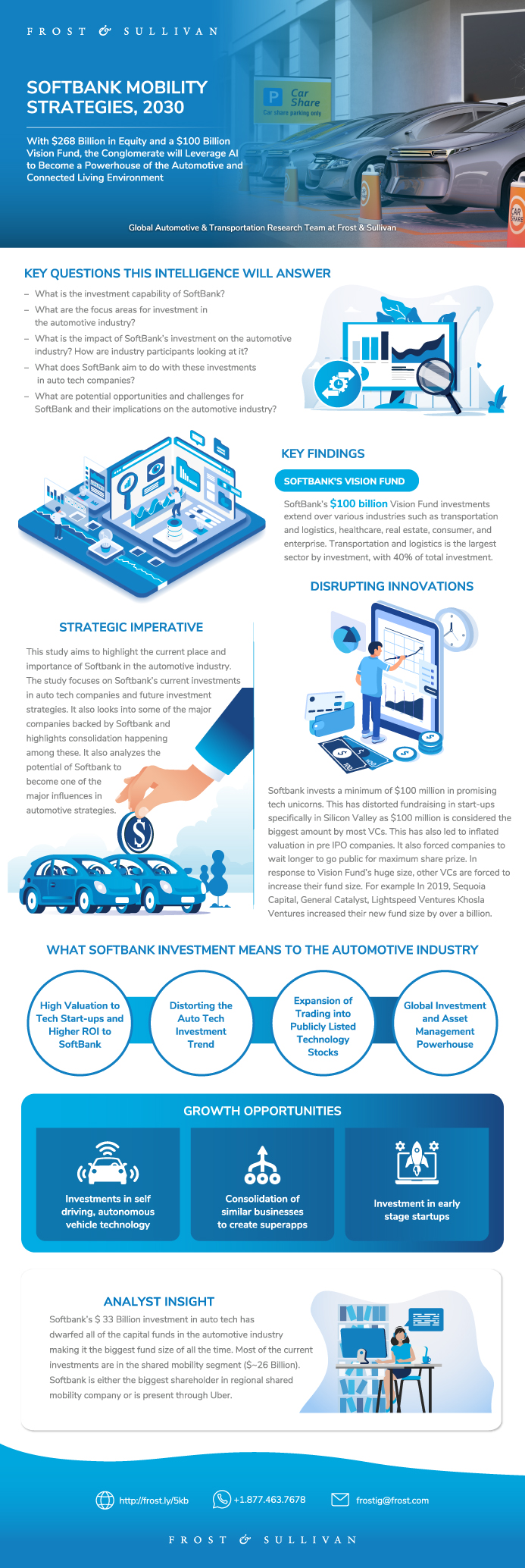
SoftBank, with its $100 billion Vision Fund, has created the biggest investment cycle in history and has given start-ups a head start to launch their technology. Investments are focused on futuristic technologies such as artificial intelligence (AI), the Internet of Things, and mobile applications across various sectors. AI will play an important role in auto technology is the central theme of SoftBank’s investment strategy. SoftBank has invested in all of the key technologies that will constitute the future mobility ecosystem, ranging from fintech and health tech to heavy logistics.
The automotive sector is the biggest investment segment for Vision Fund, with more than 40% of the total raised capital. SoftBank’s $33 billion investment in auto tech has dwarfed all of the capital funds in the automotive industry, making it biggest fund size of all the time; shared mobility and mobility-related services constitutes more than 50% of the invested capital. SoftBank is either the biggest shareholder in regional shared mobility companies or is present through Uber. The controlling stake in ride sharing competitors has allowed SoftBank to drive consolidation in this space, resulting in the emergence of local leaders. Uber, Didi Chuxing, Fair, Grab, and Ola have secured some of the biggest investments from SoftBank, which enabled them to expand their business geographically, invest in product development, and acquire start-ups complementing their business. SoftBank invested billions of dollars so these companies flourish without going public for a long time. These strategic investments are expected to reinforce the company’s plan of building one player per sector per region, thus controlling the root of modern technology living.
SoftBank has also invested in connected and self-driving vehicle technologies. The company has partnered with Toyota to form a joint venture called MONET, whose objective is to bring together SoftBank’s IoT technologies and Toyota’s autonomous vehicle platform to enable on-demand services such as mobility, logistics, and sales starting in Southeast Asia. Toyota’s E-pallet vehicle’s modular interior design will facilitate its use for various services such as mobile food preparation and shuttling people and packages.
However, some of its decisions have become classic examples of governance failure. In 2019, SoftBank had the biggest loss in operating since its inception. The loss came from its Vision Fund and Delta Fund, which had falling value of some of the portfolio companies such as WeWork , Slack, and Uber. This loss from Vision Fund also led to SoftBank group recording its first financial loss in 15 years, Vision Fund lost $16.7 billion, which led to a stock price decline of 3.2% for SoftBank. The current statistics for SoftBank investments are not as expected, and the company is also facing pressure from limited partners to improve return on their investment. SoftBank is expected to take the lessons from these incidents and redesign strategy to maintain its position.
This study aims to highlight the current place and importance of SoftBank in the automotive industry. The study focuses on SoftBank’s current and future investments in auto tech companies. It also looks into some of the major companies backed by SoftBank and highlights consolidation happening among these, and analyzes the potential of SoftBank to become one of the major influencers in automotive strategies. The study also states the challenges pertaining to SoftBank's operations and the impact on the automotive industry.
Key Findings
Overview of Automotive Investments by SoftBank
SoftBank Turning Auto Tech Unicorns into Decacorns
SoftBank Driving Mergers and Acquisitions in Shared Mobility
What SoftBank Investment Means to the Automotive Industry
How SoftBank Wants to Control the Future of Mobility
Challenges
COVID-19’s Impact on SoftBank’s Investments
Research Scope
Research Aims and Objectives
Key Questions this Study will Answer
Research Background
Research Methodology
SoftBank’s Corporate Structure
Vision Fund 1.0
Vision Fund 1.0 Investment Portfolio
SoftBank’s Financial Performance
Overview of Automotive Investments by SoftBank
SoftBank’s Automotive Investment by Region
SoftBank’s Influence on Global Shared Mobility
SoftBank—Driving Force Behind M&As in Shared Mobility
MONET for On-Demand Mobility as a Service Platform, 2030
How SoftBank Wants to Control the Future of Automotive
SoftBank’s Biggest Investments in Auto Tech—Uber Case Study
SoftBank’s Biggest Investments in Auto Tech—Didi Chuxing Case Study
SoftBank’s Biggest Investments in Auto Tech—ARM Case Study
SoftBank’s Biggest Investments in Auto Tech—Grab Case Study
IPO Timeline of SoftBank’s Auto Investments
SoftBank’s Investments in Artificial Intelligence
Vision Fund Current Portfolio and Future Investment Opportunities
Challenges
Vision Fund 1.0 Portfolio Performance
Vision Fund 1.0 Financial Overview
Vision Fund 1.0 Global Investment
Latin America Innovation Fund
Vision Fund 2.0
Future Venture Capital Funds, 2021–2030
Growth Opportunity for SoftBank
Strategic Imperatives for Success and Growth
Conclusions
The Last Word—Three Big Predictions
Legal Disclaimer
Market Engineering Methodology
The Vision Fund 1.0 Business Model
SoftBank’s Equity Value of Holding Companies
Automotive Venture Capital Firms Comparison
SoftBank and Connected Living
List of Abbreviations
List of Exhibits
List of Exhibits (continued)
Speak directly with our analytics experts for tailored recommendations.
Recent related Automotive research
19 Nov 2026 | Global | Market Research
ADAS and Autonomous Buses and Coaches, North America and Europe, 2025–2035
Bus demand is growing alongside higher capacity needs. Economic shifts, emerging business activity, and evolving purchasing behaviors have also increased the need for quicker transfers. To improve efficiency across their operations, bus operators are beginning to trial more advanced technologies, es...
18 Nov 2026 | Global | Frost Radar
Frost Radar™: Transportation Management Systems, 2026
The transportation management system (TMS) market is undergoing a transformation as organizations seek greater supply chain resilience, real-time visibility, automation, and intelligent decision-making. Transportation complexity, multimodal and cross-border freight flows, sustainability requirements...
18 Nov 2026 | Global | Megatrends
Top Megatrends in Mobility
The global mobility industry is undergoing a fundamental transformation as technological innovation, urbanization, sustainability imperatives, and evolving consumer expectations reshape how people and goods move. This study explores the megatrends shaping the future of mobility, moving beyond conven...
16 Nov 2026 | Global | Market Research
Car Accessories Market, GCC, 2022–2030
This study assesses the Gulf Cooperation Council (GCC) car accessories market across Saudi Arabia, the UAE, Kuwait, Oman, and Qatar, covering seven product families—from transportation and wheels to personalization and performance.In 2025, the market was valued at $411.1 million, and it is forecast ...
06 Nov 2026 | Europe | Market Research
Strategic Analysis of Value Line Parts and Lubricants for MHCVs in Europe
This study provides an in-depth assessment of the European medium- and heavy-duty commercial vehicle (MHCV) value line parts and lubricants aftermarket from 2025 to 2030. The market is experiencing a period of rapid evolution as fleet operators face increasing pressure to reduce maintenance costs, e...
Purchase includes:
- Report download
- Growth Dialog™ with our experts
Growth Dialog™
A tailored session with you where we identify the:- Strategic Imperatives
- Growth Opportunities
- Best Practices
- Companies to Action
Impacting your company's future growth potential.