 USD
USD GBP
GBP  CNY
CNY  EUR
EUR  INR
INR  JPY
JPY  MYR
MYR  ZAR
ZAR  KRW
KRW  THB
THB 


Technology Strategy Focusing on Tailor-made Products for Electric and Hybrid Electric Vehicles
18-Jan-2021
Global
Market Research
MFED-01-00-00-00
CM01849-GL-MT_25179
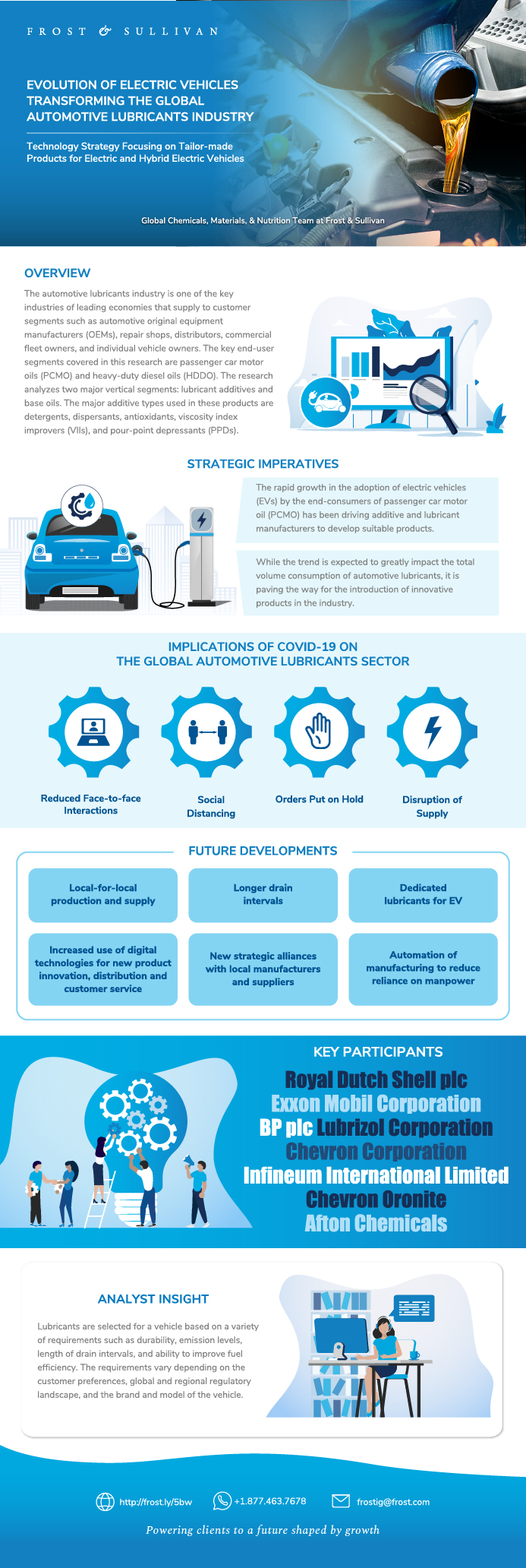
The automotive lubricants industry is one of the key industries of leading economies that supply to customer segments such as automotive original equipment manufacturers (OEMs), repair shops, distributors, commercial fleet owners, and individual vehicle owners. The key end-user segments covered in this study are passenger car motor oils (PCMO) and heavy-duty diesel oils (HDDO). The study analyzes two major vertical markets: lubricant additives and base oils. The major additive types used in these products are detergents, dispersants, antioxidants, viscosity index improvers (VIIs), and pour-point depressants (PPDs). The trend of the use of various base-oil groups Group I (<90% saturates, >0.03% sulfur, 80-120 viscosity index (only mineral oils)), Group II (≥90% saturates, ≤0.03% sulfur, 80-120 viscosity index (only mineral oils)) and Group III (≥90% saturates, ≤0.03% sulfur, ≥120 viscosity index (Includes synthetic oils and other oils)) is analyzed.
Lubricants are selected for a vehicle based on a variety of requirements such as durability, emission levels, length of drain intervals, and ability to improve fuel efficiency. The requirements vary depending on the customer preferences, global and regional regulatory landscape, and the brand and model of the vehicle. This report tracks the industry’s transformation and seeks to identify future opportunities that exist for lubricant manufacturers. The study analyses the change in the product landscape because of the high growth of electric vehicles (EVs) and variants in the automotive industry. The market for automotive lubricants and additives is greatly impacted by other Mega Trends such as the Covid-19 pandemic, changing international trade relationships, sustainability targets adopted by governments and regulatory authorities, and the miles driven by end customers around the world. The competitive environment in the lubricant additives market is highly skewed towards the larger market participants because of the high entry barrier for new entrants due to the significant amount of capital expenditure required. On the other hand, the finished lubricants market is highly fragmented amongst the smaller participants, while the major share of the market is held by a few global companies. The automotive lubricants and additives face regulatory pressure from organizations such as the US Environmental Protection Agency (US EPA) and REACH that mandate the use of products with reduced emissions. They are also mandated to adhere to the specifications put forth by organizations such as the American Petroleum Institute (API), International Lubricants Standardization and Approval Committee (ILSAC), Japan Automobile Manufacturers Association (JAMA), and the European Automobile Manufacturers Association (ACEA). There is an increasing trend of customers demanding lower viscosity oils that also provide for higher drain intervals between oil changes. Manufacturers are increasingly investing in product development to enhance environmental sustainability and product efficiency. The research analyzes the global automotive lubricants and additives market. Volume and revenue forecasts have been provided from 2017 to 2027. At the sub-segment level, the analysis focuses on the additive types and base-oil groups used in these products. Competitive structure and market share data have been provided at the top level. The base year is 2020 and the forecast period ends in 2027.
Author: Christeena Thomas
Why is it Increasingly Difficult to Grow?
The Strategic Imperative 8™
The Impact of the Top Three Strategic Imperatives on the Automotive Lubricants Industry
Growth Opportunities Fuel the Growth Pipeline Engine™
Global Automotive Lubricants Market—Scope of Analysis
Market Definitions
Geographic Scope
Key Growth Metrics for Automotive Lubricants Market
Implications of Covid-19 on the Global Automotive Lubricants Market
Other Major Factors Affecting the Global Automotive Lubricants Market
Global Automotive Lubricants Market—2018 Drivers vs. Current Status
Global Automotive Lubricants Market—2018 Drivers vs. Current Status (continued)
Global Automotive Lubricants Market—2018 Restraints vs. Current Status
Global Automotive Lubricants Market—2018 Restraints vs. Current Status (continued)
Market Forecast—Global Automotive Lubricants Market
Revenue Forecast by Component—Global Automotive Lubricants Market
Volume Forecast by Component—Global Automotive Lubricants Market
Percent Volume by Base-oils and Additives—Global Automotive Lubricants Market
Percent Volume by Base-oils and Additives—Global Automotive Lubricants Market (continued)
Demand Trends by Base Oil Groups 2020—North America
Demand Trends by Base Oil Groups 2020—Europe
Demand Trends by Base Oil Groups 2020—APAC
Demand Trends by Base Oil Groups 2020—Middle East
Percent Revenue Forecast by Region
Percent Volume Forecast by Region
Regional Forecast Discussion
Automotive Lubricants and Additives—Regulations
Automotive Lubricants and Additives—Recent Developments in Regulations
Value Chain
Value Chain Description
Automotive Lubricants Market—Competitive Environment
Automotive Lubricant Additives—Competitive Environment
Global Lubricants Market—Future Trends
Local-for-Local Production and Supply Powered by Strategic Partnerships with Local Stakeholders
Investment in Digital Technologies
Longer Drain Intervals
Opportunities for Lubricant Additives in the EV Market
Growth Opportunity 1—Lubricants for Electric Vehicles, 2020
Growth Opportunity 1—Lubricants for Electric Vehicles, 2020 (continued)
Growth Opportunity 2—Increased Focus on New and Refill Demand from On-road Commercial Vehicles, 2021
Growth Opportunity 2—Increased Focus on New and Refill Demand from On-road Commercial Vehicles, 2021 (continued)
Growth Opportunity 3—Dispersants and Base-oils to Reduce Viscosity of Lubricants, 2021
Growth Opportunity 3—Dispersants and Base-oils to Reduce Viscosity of Lubricants, 2021 (continued)
List of Exhibits
Legal Disclaimer
Speak directly with our analytics experts for tailored recommendations.
Recent related CASE & Construction Chemicals research
24 Jul 2026 | Global | Market Research
Regulatory Trends Impacting the Chemical Industry, 2026
This study analyzes the impact of evolving regulatory frameworks across the chemical industry, focusing on both product-level and end-industry regulations. The scope spans key product segments including coatings, adhesives and sealants, polymers and composites, fuels and lubricants, and process chem...
22 Apr 2026 | Global | Technology Research
Data-Driven Materials Informatics for Accelerated Polymer, Coatings, and Catalyst Innovation
Data-driven materials informatics is transforming the discovery and development of advanced materials, enabling faster innovation across polymers, coatings, and catalytic systems. By integrating experimental data, computational simulations, and AI and ML models, these platforms enable predictive des...
10 Mar 2026 | Global | Strategic Imperatives
Top 10 Strategic Imperatives in the Construction Materials Industry, 2026
This report examines the key strategic transformations shaping growth in the construction materials industry throughout 2026 and beyond. It analyzes the impacts of geopolitical instability on supply chains, resulting in cost volatility, increased localization of production, and diversification of ra...
22 Jan 2026 | Global | Technology Research
Nanoporous Catalysts for Optimized Efficiency in Chemical Processing and Industrial Reactions
Global industries are entering a new phase of efficiency-driven transformation, where material innovation underpins competitive advantage and sustainability compliance. Within this landscape, nanoporous catalysts have emerged as a pivotal enabler—driving faster reaction kinetics, superior selectivit...
24 Dec 2025 | Global | Market Research
Digital Transformation in the Construction Materials Industry, Global, 2025
Digital transformation in the building materials industry involves integrating digital technologies and data-driven processes across every facet of a company’s operations, including supply chain management, design, production, sourcing, and customer interactions. The goals are to increase productivi...
Purchase includes:
- Report download
- Growth Dialog™ with our experts
Growth Dialog™
A tailored session with you where we identify the:- Strategic Imperatives
- Growth Opportunities
- Best Practices
- Companies to Action
Impacting your company's future growth potential.
| Deliverable Type | Market Research |
|---|---|
| No Index | No |
| Podcast | No |
| Author | Christeena Thomas |
| Industries | Chemicals and Materials |
| WIP Number | MFED-01-00-00-00 |
| Is Prebook | No |
| GPS Codes | 9800-A6,9100-A2,9869-A2,9801-A6,9595,9870 |
Evolution of Electric Vehicles Transforming the Global Automotive Lubricants Industry
$2,450.00
Special Price $1,837.50 save 25 %